

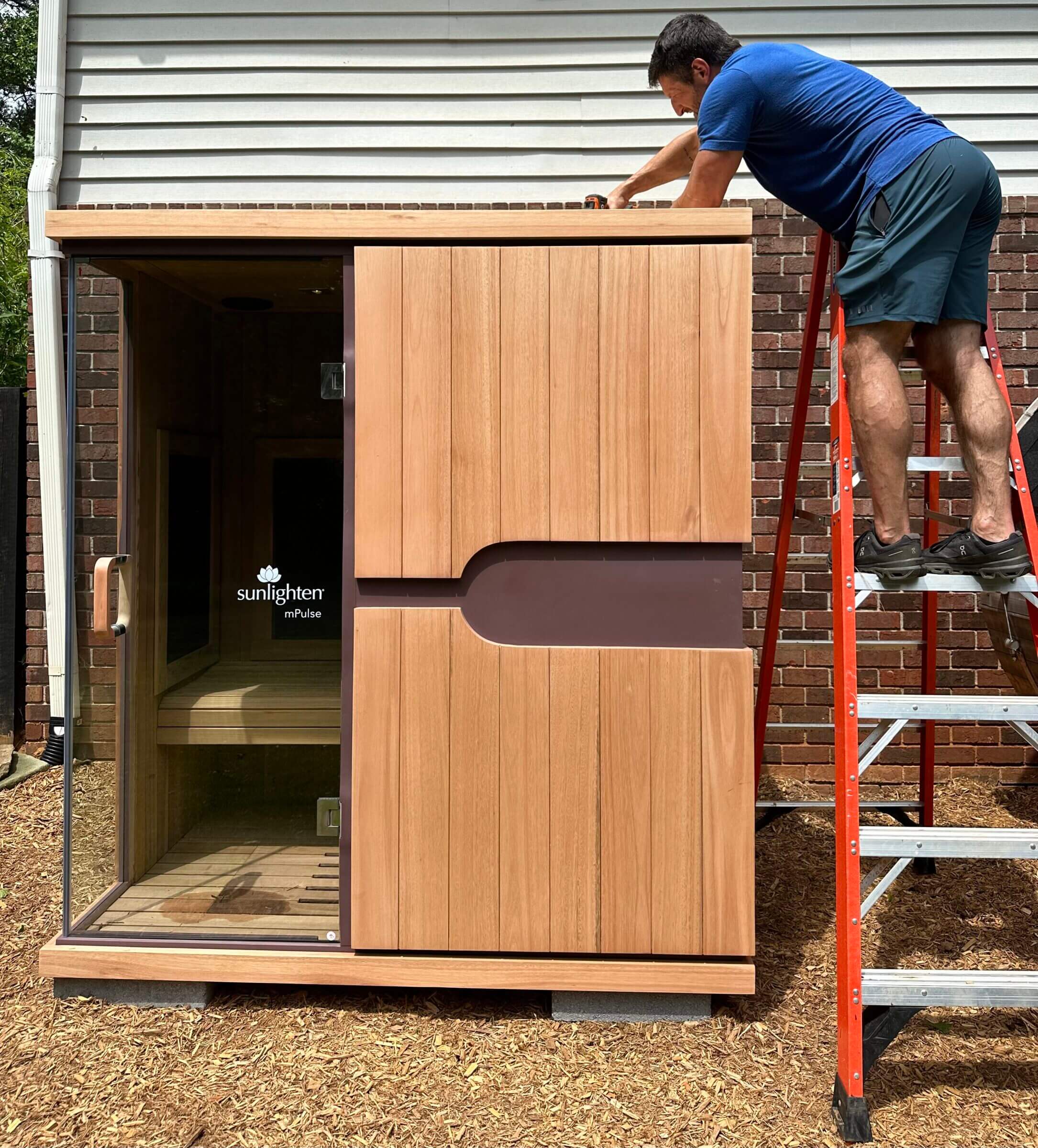
I’ve owned and tested dozens of traditional and infrared saunas over the years, including Sunlighten’s mPulse Conquer Smart Sauna, which has been my go-to IR cabin since I first assembled it back in 2022.
I’m still a big fan of the mPulse, which is the most feature-rich infrared sauna I’ve used to date. In particular, the mPulse is unique in that allows users to independently control the near, mid and far infrared wavelengths (as well as red light) for precise customization based on specific health goals.
But in this review, I’ll explain why I’ve decided to switch from the mPulse to the Sunlighten Amplify, as well as everything you need to know about the features and performance of this incredibly hot infrared sauna.
Key Takeaways
The Sunlighten Amplify hits 170 degrees in roughly 30 minutes, making it the hottest and fastest-heating infrared sauna I’ve tested. The performance comes from four SoloCarbon far-infrared heaters (independently tested at 96-99% emissivity) plus four halogen full-spectrum heaters that drive cabin temperature up quickly. The build quality is the best of any sauna I’ve owned, thanks to a double-pane glass door, tighter door seals, and wooden slats over the heater fabric (which allow you to lean back without damaging the LEDs).
Pros
- ✓Gets exceptionally hot for an IR sauna.
- ✓Excellent emissivity, which helps maximize the health benefits.
- ✓Features a roomy four-person cabin (and every seat is close to a heater).
- ✓Does not have a WiFi radio, which means lower EMF exposure than connected models like the mPulse.
- ✓Magnetic, mostly screw-free wall assembly (my wife and I built the Amplify IV in about three hours).
- ✓Exceptional build quality and low/no-VOC materials.
Cons
- ✕Three of the four full-spectrum heaters sit under the benches, so they contribute almost nothing in terms of NIR or skin-depth benefits.
- ✕No red light therapy and no individual wavelength control, both of which the mPulse offers.
- ✕No mobile app, so you can’t start a session from inside the house.
- ✕Requires a dedicated 240V/20A circuit, plus a NEMA 6-20 extension cord and L6-20P adapter if you’re tapping an existing twist-lock outlet like I did.
- ✕The longer bench’s recliner faces away from the second bench.
First off, it’s worth noting that while the Amplify is relatively easy to assemble, I did have to ask my wife for assistance, considering the size and weight of the wall modules and roof of our four-person model.
If you purchase the two-person Amplify, you may be able to assemble the sauna without a second adult’s help.
After having used Sunlighten saunas for many years, it’s fair to say that they have improved the quality of our lives. If you’re new to sauna bathing and, in particular, infrared saunas, I encourage you to read my in-depth list of the top infrared sauna health benefits.
Sunlighten Amplify Full-Spectrum Infrared Sauna Review

Sunlighten’s core product portfolio consists of three sauna cabins: the Signature, Amplify, and mPulse series.
The Amplify series is the company’s hottest, featuring a combination of SoloCarbon (far-infrared) and halogen (full-spectrum) heaters.
The former delivers a high quantity and quality of far-infrared light for deep-tissue penetration, while the latter raises the cabin temperature to induce greater heat stress and to shorten heat-up times (which is especially helpful during winter, when ambient temperatures are low).

Right off the bat, there are a few things I really like about the Amplify in comparison to the mPulse. These include its double-pane glass door, improved seals around the door opening (both of which keep more heat inside the cabin), and the wooden slats covering the heater fabric (which allow you to lean back without risking damage to the heaters’ LEDs). In contrast, my mPulse had a single-pane glass door and only fabric covering the heaters.
I should note that your ability to lean back on the heaters definitely depends on how heat tolerant you are. I can handle it, but Sunlighten also offers an optional backrest you can use. The photo below shows my brother-in-law using it…

I also appreciate the intuitive control panel you can use to turn the sauna on and off (as well as its various lighting elements), and to adjust the timer and temperature. While the Amplify (unlike the mPulse) doesn’t come with a touchscreen, you can stream music to the built-in speakers from a Bluetooth-enabled device such as your smartphone.
Capacity, Size and Dimensions

The first full-size Sunlighten sauna we ever had was a two-person mPulse Believe, followed by a three-person mPulse Conquer.
This time around, we intentionally skipped the two-person and three-person models and went straight to the four-person Amplify IV because it has enough room in the cabin to allow me to stretch out or enjoy it with (more) friends.

With exterior dimensions of approximately 80x56x78 inches, there was no chance of setting up the Amplify inside our 860-square-foot modular home. But fortunately, our outside spa area sits on 45 acres, giving us more than enough space for the Amplify and the rest of our spa gear.
For reference, here’s a quick comparison of the dimensions of the different Amplify cabin sizes:
Amplify Size at a Glance
Three cabins rendered in 3D at the same scale, with identical heights and different floor footprints.It’s only been a few weeks since we installed the Amplify, but both my wife and I are already loving the larger cabin. The other day, Kathy stretched out on the recliner bench while I had plenty of room on the second bench to extend my legs and lean back against the side heaters.
Another thing I really like about the Amplify is that, regardless of where you sit, you’re always close to several heaters. With the three-person mPulse, we had a dedicated “hot seat” that provided better heater coverage than the other side of the bench (in front of the glass door). That’s no longer an issue with the Amplify IV.
As you can see in the graphic above, Sunlighten offers different heater configurations depending on the cabin size. As a result, heat-up times and maximum cabin temperatures may vary, and it’s entirely possible that the smaller 3-person Amplify performs slightly better than the larger four-cabin model we have.
To get more details on the individual specs of each sauna model, check out this Amplify overview page and click on the capacity you’re interested in.
Materials and Craftsmanship


In addition to the capacity options noted above, the two-person and three-person Sunlighten Amplify also comes in two wood finishes (Eucalyptus and Basswood), whereas the four-person Amplify is only available in Eucalyptus.
What’s important to note is that the Basswood model is intended for indoor use only, while the Eucalyptus option can be used outdoors, though it should be paired with a separate cover to protect the delicate electronics beneath the roof.
Regardless of which wood option you choose, you should know that both come from responsibly managed forests and look great.
For what it’s worth, our first mPulse was made with basswood, and our second mPulse had a eucalyptus/cedar finish. I’ve liked all three and especially love the smell of cedar wood, but Cedar is no longer offered as an option. So eucalyptus or basswood are your two choices.
Infrared Heaters


One of the things that sets Sunlighten saunas apart from other infrared saunas on the market is their high-emissivity heaters.
Emissivity is a measure of how efficiently a material radiates infrared energy compared to a theoretical perfect emitter, expressed as a value between 0 and 1 (or as a percentage). In the context of infrared saunas, emissivity tells you what fraction of the electrical energy fed into a heater actually gets converted into usable infrared radiation that penetrates your body, versus being lost as ambient convective heat. A heater with 95% emissivity delivers far more therapeutic infrared energy per watt than one rated at 70%, even if both reach the same surface temperature.
This matters because the health benefits people associate with infrared saunas – like improved circulation, detoxification through sweat and faster recovery – come largely from infrared light penetrating tissue, not from air temperature alone.
In other words, two saunas can feel similarly hot inside the cabin while delivering very different doses of actual infrared radiation.
Sunlighten’s SoloCarbon heaters are independently tested to have around 96-99% emissivity, which is why I consider them among the best in the industry. Many cheaper saunas use ceramic or carbon panels in the 80-90% range, and some don’t publish third-party emissivity data at all (which is usually a red flag).
As I mentioned before, the Sunlighten Amplify IV is equipped with four far-infrared heaters that drive most of the sauna’s benefits. They’re strategically positioned on the side and back walls, as well as the right front wall (opposite the glass door).
Additionally, Sunlighten included four halogen full-spectrum infrared heaters. Three of these heaters are located under the two benches and are predominantly meant to increase the air temperature inside the cabin (and to prevent your feet from cooling down when it’s really cold outside; hot air rises, and you might end up with a pocket of cold air inside a sauna without floor heaters).
The fourth and more powerful full-spectrum heater is located in the corner between the glass door and the left-side wall, providing infrared coverage from the front and additional heat to mitigate heat loss through the glass door.
How My Body Responds to 170°F

I’ve argued in past reviews that air temperature inside an IR cabin doesn’t drive the benefits — the FIR dose penetrating your tissue is what matters most.
I tested that thesis directly in my infrared vs. traditional sauna experiment, where my mPulse produced a comparable cardiovascular response to a much hotter traditional sauna. I still stand by that assessment.
What the Amplify changes is the cumulative heat stress that gets layered on top of the IR dose. Sitting in a 170-degree cabin while four high-emissivity FIR heaters drive deep tissue penetration isn’t the same experience as sitting in a 140-degree or 160-degree IR cabin with the same heater quality.
Whether that extra heat stress translates to additional health benefits is an open question — I haven’t seen research that isolates the variable cleanly — but the intensity is undeniable.
Here’s what my AmazFit Balance 2 smartwatch captured during 30-minute sessions:
How Hard Each Sauna Pushed My Heart
Peak heart rate over matched 30-minute sessions (AmazFit Balance 2)The Amplify is one of the few infrared saunas in my home spa that consistently pushes me toward my physiological limit at the 30-minute mark. I sometimes feel dizzy by the end, and I’ve had sessions where I needed to bail at the 15-minute mark (usually when I’m dehydrated, under-slept, or am carrying more stress than usual).
That fluctuation isn’t unique to the Amplify, but this sauna makes it more obvious because the heat doesn’t give me much room to coast.
In other words, my mPulse was also capable of producing that feeling, but not as quickly or as consistently; on most days, I could comfortably sit through 30-minute sessions without approaching the wall.
The Amplify changes that math.
So if you’re switching from a lower-temperature IR cabin and you’re used to long, easy sessions, be prepared to face a new challenge.
Where the Amplify Falls Short of the mPulse
When people compare infrared saunas, “full-spectrum” is one of the most marketed features. But where the full-spectrum heaters sit inside the cabin matters as much as whether they’re there at all, and this is the one area where the Amplify falls noticeably short of my previous mPulse.
It’s a trade-off I knew I was making, but it’s worth understanding the pros and cons before you decide between the two.
First off, infrared saunas deliver benefits across three wavelength bands:
- Near-infrared (NIR) is the band associated with photobiomodulation, which is the cellular-level effect behind red light therapy (which usually includes NIR). It’s connected to skin health, collagen production, wound healing, and surface-level recovery. Most photobiomodulation research uses LED panels positioned within a few inches of the skin, because intensity drops off quickly with distance from the source.
- Mid-infrared (MIR) penetrates a few millimeters into soft tissue and is associated with superficial circulation and muscle warmth.
- Far-infrared (FIR) drives the heat-stress response. Cabin temperature and core body temperature are what matter here, and that’s where most of the cardiovascular and detoxification benefits people associate with sauna bathing come from.
The mPulse delivers all four bands (NIR, MIR, FIR, and red light) from heaters built into the back and side walls. When you sit on the bench, those heaters are inches from your back, shoulders, and upper body – which is close enough to deliver a meaningful NIR and MIR dose to your skin.
The Amplify is a different story. Three of its four full-spectrum heaters sit under the benches, where they’re great for raising air temperature and preventing cold pockets around your feet but functionally useless for anything skin-related (unless you care about photobiomodulation for your calves).
The fourth full-spectrum heater sits in the corner between the glass door and the left wall, so unless you’re sitting directly across from it on the longer bench, you’re not in its effective range either.
The bottom line: if your primary reason for buying an infrared sauna is heat stress, sweating, and the systemic benefits that come from raising your core temperature, the Amplify is the better tool.
If you want a sauna that also doubles as a skin-health or surface-level recovery device – whether that’s treating acne on your upper body, supporting collagen production, or running red-light-style protocols – the mPulse remains the more capable choice.
For me, heat stress is what I was after, so the trade-off was worth it.
Sauna Programs

Unlike the Sunlighten mPulse, the Amplify doesn’t offer dedicated sauna programs or the ability to turn on or off certain wavelengths of infrared light.
However, you can turn the full-spectrum infrared heaters on or off to maintain a lower cabin temperature or to conserve electricity (e.g., if you want to enjoy a sauna session during a power outage while your house runs on batteries or solar power).
You can also schedule a sauna session via the built-in control panel. For example, you can create a schedule to turn the sauna on in X hours. While that’s not quite as sophisticated as the calendar scheduling feature the Sunlighten app offers for the WiFi-connected mPulse, you could use it to have the sauna hot and ready in the morning.
There’s also a “commercial” mode you can unlock via the control panel that lets you keep the sauna on for several hours in a row (the normal residential session time is capped at 60 minutes).
I don’t think the lack of programs or wavelength customization is a big deal if your primary use case for sauna bathing is to induce heat stress.
The practical difference is control. The mPulse’s SoloCarbon heaters emit all three infrared bands (near, mid, and far) and red light from the same panels, and the control panel lets you dial each band up or down independently, or run preset programs that bias toward one band depending on the goal.
The Amplify’s halogen full-spectrum heaters sit under the bench and in a corner. They emit all three wavelengths (not red light), but you can’t separate them, and their main job is to raise the cabin temperature rather than deliver a targeted dose of a specific wavelength.
As I explained in the previous section, where that matters is when you want to do anything other than induce heat stress.
Near-infrared and red light are both associated with photobiomodulation, so the mPulse lets you run a lower-heat session that emphasizes those wavelengths if your goal is skin or surface-level recovery rather than sweating. With the Amplify, the heaters are too far from your skin to deliver any meaningful NIR benefits, and there’s no red-light component at all.
For most people chasing cardiovascular and heat-stress benefits, this doesn’t change much. Far-infrared does the heavy lifting in both saunas, and the Amplify actually runs hotter than the mPulse, so heat stress isn’t a concern. Wavelength control becomes more relevant if you want to follow specific protocols targeting NIR or red light exposure.
For what it’s worth, this article goes into detail about the benefits of visible red light in IR saunas; if you’re on the fence between the Amplify and mPulse, it’ll give you plenty of information to help you decide whether red light is an important factor for your specific use cases.
Assembly and Installation
One thing that sets Sunlighten apart from most other brands is how easy it is to assemble their saunas.
All the major components, including the walls and roof, can be assembled without screws, nails or bolts. Instead, the walls lock together using magnets and U-shaped hooks, and the roof is held in place by its weight (and overhangs on each side to prevent it from sliding around).

Despite the easy-to-follow assembly instructions, it’s worth noting that you’ll likely need the help of a second (or third) adult to move the wall and roof panels into place, because they’re heavy.
That’s particularly true for the four-person cabin; I had to ask my wife for help lifting the various panels and holding them in place while I connected them.
While the main parts of the sauna didn’t require the use of screws, a few parts did, including the door handle and the full-spectrum heaters on the inside.
The most time-consuming part of the assembly was removing (and putting back) two dozen screws on top of the sauna to expose the electronics and connect all the cables to their respective control modules.
The images below will give you a sense of how the assembly comes together.


All in all, it took my wife and me about three hours from start to finish to set up the sauna, not including the installation of a dedicated 240V 20A electrical circuit we had already done months earlier. (This is a requirement for the Amplify.)
The only two things I had to procure separately were a NEMA 6-20 extension cord and a NEMA L6-20P to 6-20R adapter so I could plug the sauna into our existing 240V outlet.

Once everything was set up and connected to power, it was time to clean up. As you can imagine, we were left with an overwhelming amount of cardboard boxes (which the individual components shipped in).
Fortunately, cardboard is carbon, and you can never have enough of it if you’re trying to grow food. So, we used most of the larger cardboard pieces as compostable weed barriers in our raised garden beds, and we tossed smaller pieces on the compost pile.
If you don’t have a use for all of that cardboard, you’ll have to find another way to dispose of it, as your regular recycling bin is definitely not large enough to hold all the packaging.
I’d also encourage you to level the spot where you intend to install the sauna. Our outside spa area is covered in pea gravel, but it isn’t completely level. As a result, I used some cinderblocks and pressure-treated lumber to provide a level surface.
Skipping this step means the sauna door may not open, close and seal properly — and it’s much harder to fix this problem after the sauna is fully assembled.
For what it’s worth, I neglected to properly level when we installed our first Sunlighten mPulse, and we had to use shims to get the sauna somewhat level after the fact. That’s neither ideal nor aesthetically pleasing.
Maintenance

The ongoing maintenance required for Sunlighten saunas is relatively straightforward, depending on whether you have your sauna outdoors or indoors.
Our Amplify sauna is located outdoors, in our dedicated spa area. That means we constantly bring in debris that sticks to our feet and needs to be vacuumed every so often. If you have your sauna indoors or use a floor mat (we haven’t gotten around to purchasing one) in front of the entrance door, there shouldn’t be a need for regular vacuuming.
One part of the sauna that you might be cleaning more often is the glass door, because it attracts fingerprints and smudges. Sunlighten sells a natural cleaning kit you can use for the glass and wood interior, but any natural cleaner should do.
Just don’t use any harsh chemicals on the inside of your sauna. You don’t want to inhale those toxins or get them onto your skin (especially with your pores wide open), and the chemicals might damage the wood.
Sunlighten also suggests using light sandpaper to remove stains from the wood interior. The idea is to remove a very thin layer of the stained wood without damaging it.
Ventilation

The Amplify features ventilation slats in the ceiling that you can open or close to allow stale air and humidity to escape from the cabin.
The problem with operating the sauna outdoors is that the rain cover renders those vents relatively ineffective. As a result, we typically keep the sauna door open for a few minutes after a session to allow any residual moisture to escape.
Regardless of where you install the Amplify, I recommend leaving a couple of inches of clearance on all sides of the sauna to allow for proper airflow.
Control Panel and Speakers


The Amplify is equipped with an easy-to-use control panel that lets you turn the sauna on or off, turn the full spectrum heaters on or off, turn on the exterior and interior accent lighting and chromotherapy (see below), and adjust the session time and temperature.
Additionally, you can activate “reservation mode” by pressing the timer up and timer down buttons simultaneously. Once in reservation mode, you can schedule the sauna to automatically turn on in X hours.
Similarly, you can activate “4-hour timer mode” by pressing the power button until the timer display reads (4h). This mode enables you to keep the sauna on for up to four hours, and it’s meant for demos in commercial settings.
Much like the mPulse and other Sunlighten saunas, the Amplify comes with two Blaupunkt stereo speakers that deliver decent sound. Don’t expect a theater-like experience, but the speakers are plenty loud and clear, with sufficient bass for streaming music from a BT-enabled phone or audio player.
EMF Testing


I tested the Amplify with my TriField TF2 meter to see how the heaters performed across all three EMF categories.
All of the readings below are in weighted mode, which is the meter’s setting that adjusts the raw electric and magnetic field readings based on how the body actually absorbs different frequencies, so higher-frequency exposure counts for more than lower-frequency exposure at the same field strength.
It’s the mode TriField recommends for evaluating biological-effect concerns, and it’s what I use across all my EMF testing for consistency.
Radio frequency (RF). My baseline around the outdoor spa area sits at 0.002 mW/m² with occasional peaks around 0.564 mW/m² from ambient WiFi reaching the spa from our house. When I powered the Amplify on, those numbers didn’t change. There’s no WiFi radio inside the cabin, no app-pairing module, no Bluetooth chatter beyond the audio receiver when it’s actively paired to a phone. The Amplify adds zero RF on top of whatever’s already in the air at your install location.
That’s a meaningful difference from my previous mPulse, which had WiFi built in for the Sunlighten app and added an RF source you couldn’t fully eliminate without disconnecting the unit.
Electric and magnetic fields at the heaters:
- SoloCarbon FIR panels: 757 V/m electric (measured directly on the surface), 0.0 mG magnetic
- Halogen full-spectrum heaters: 85 V/m electric, 11.1 mG magnetic
The split between the two heater types reflects how each technology operates. Carbon-element heaters produce a relatively high electric field but essentially no magnetic field because they’re low-amperage resistive elements. Halogen heaters draw more current to reach their higher operating temperature, which produces a measurable magnetic field but a much lower electric field.
For reference, when I tested the halogen heaters in my Sun Home Luminar 2 video review, magnetic readings spiked to roughly 50 mG when the heaters were firing — meaningfully higher than the Amplify’s 11.1 mG.
Now, different heater count, different power draw, and different measurement geometry all play into that gap, but if you track magnetic exposure during sauna sessions, the Amplify reads lower than the only other halogen-heated IR cabin I’ve personally tested.
There are no official EMF safety standards in the U.S. that apply directly to consumer saunas, so I’m publishing the raw numbers and letting you decide whether they fit your personal tolerance.
For my use case — several sessions per week at 30 minutes each — they’re well within what I’m comfortable with.
Chromotherapy

As with all Sunlighten saunas, the Amplify comes with internal lighting to facilitate color therapy (aka chromotherapy).
I won’t repeat everything I wrote about chromotherapy in my Sunlighten Solo review, but in a nutshell, color therapy may positively impact the release of certain hormones (such as serotonin) that have calming effects, while also providing a range of other benefits.
Sunlighten has implemented chromotherapy via ceiling-mounted light strips that you can operate using a remote control. For example, you can set a specific color (depending on the benefits you want to achieve), or enable a mode that alternates between different colors.
What’s new with the Amplify is a wall-mounted holder for the remote control.
Pricing: Is the Sunlighten Amplify Worth It?
The short answer is yes — but the longer answer is what actually matters when you’re spending this much money.
Sunlighten sells premium saunas and their pricing reflects that reality. The least expensive model in their lineup (the Sunlighten Solo) starts at $2,600, and the Amplify IV sits well above that mark.
You can find “full-spectrum” infrared saunas online for a fraction of what Sunlighten charges, and on paper the specs often look comparable. In practice, however, there are major differences that make those cheaper options a far less worthwhile investment.
The biggest difference is heater quality.
Sunlighten’s SoloCarbon heaters are independently tested at 96-99% emissivity, which means more of the electricity you pay for actually becomes therapeutic infrared rather than ambient air heat. A lot of cheaper carbon and ceramic panels sit in the 80-90% range, and many low-cost brands don’t publish third-party emissivity data at all.
Build quality is the second area where that price difference matters.
The Amplify is built from eucalyptus and basswood sourced from responsibly managed forests, without the composite panels and chemical adhesives you’ll find in lower-end cabins.
I’ve stepped into so-called “premium” saunas from other brands where the smell of glue hit me within seconds of opening the door. That’s never been the case with any of the three Sunlighten cabins I’ve owned since 2022.
Finally, there’s the broader market context.
The infrared sauna category is full of brands making aggressive claims about weight loss, detox, and red-light-style benefits, — often borrowing language from photobiomodulation research that their own heaters can’t actually deliver.
Sunlighten’s marketing is measured by comparison, and they invest in research partnerships rather than influencer hype. That matters when you’re spending money on something you’ll use multiple times a week.
Sunlighten doesn’t publish pricing because each system is configurable, so to get a quote for the exact model you’re interested in, use this link and mention promo code “Michael Kummer.” That’ll knock $500 or $600 off your quote depending on the size of the sauna.
Sunlighten also offers 0% financing, which you can explore after you receive the quote.
What I Would Improve

Overall, the Amplify IV is the nicest and highest-quality sauna I’ve ever owned, and my wife and I thoroughly enjoy using it.
But there is one thing I’d change: the bench configuration.
The larger bench (running along the back wall of the sauna) features a reclining back and leg rest, which is awesome for lounging. The problem is that the backrest butts up against the second bench. In other words, if my wife lounges on the larger bench (with the recliner propped up), she faces away from me (sitting on the second bench). That makes conversations feel a bit awkward because you can’t maintain eye contact unless the person in the recliner turns their head.
The second issue with this inconvenient bench configuration is that the bench cushions Sunlighten sells as an add-on are not sized to allow the backrest of the longer bench to be engaged without removing the cushion of the smaller bench.
If I had a say in product development, I’d move the back rest of the longer bench to the opposite side so that the person lounging on the bench faces the second (smaller) bench. Additionally, I’d resize the cushions so they’re just long enough to cover their benches, rather than letting the cushions on the shorter bench extend onto the longer bench.
If the images above don’t illustrate the problem I’m trying to describe here well enough, I’d encourage you to watch my full video review.
Another feature request I’d have is to enable remote control of the sauna via the built-in Bluetooth radio (currently used for streaming audio to the sauna’s built-in speakers). I realize Bluetooth range is limited, but my office is within range of our outdoor spa area, and it would be incredibly convenient to turn the sauna on from inside our home.
How We Use the Sunlighten Amplify Full-Spectrum Infrared Sauna
My wife and I use the Amplify several times a week, but not on a fixed schedule. Traditionally, we sauna bathe more frequently in winter than in summer, considering that spending time outside during the hot and humid Georgia summers feels like you’re in a sauna.
Most of the time, we combine sauna bathing with cold plunging. On days when we have more time, we go back and forth between the sauna and the cold plunge 2-3 times, but normally we just end the sauna session with 2-3 minutes in the plunge to close our pores and energize us for the rest of the day.
On days we do contrast therapy close to bedtime, I limit my stay in the cold plunge to a minute or so as not to get too hyped up.
One thing I like about the Amplify is how quickly it heats up (compared to most other infrared saunas I’ve owned). Depending on the ambient temperature, it takes about 30 minutes to get hot enough for me to start sweating as soon as I sit down.
Final Verdict: Why the Amplify Fits Our Current Sauna Priorities

The mPulse is a great sauna and we loved using it for three years. Our decision to switch to the Amplify was based on three primary factors.
The first is the cardiovascular angle.
Most of my interest in sauna bathing comes down to pushing my body’s heat-stress response: the cardiovascular workout, the sweat, the systemic effects that show up in research on Finnish-style traditional saunas. Once I learned the Amplify could hit 170° – significantly hotter than the mPulse and well into territory I usually only get from traditional saunas – I wanted to know what that extra heat would feel like in practice.
The second factor was space.
The two-person and three-person Sunlighten cabins we’d owned previously worked fine when it was just Kathy and me sitting upright, but the four-person Amplify IV gives us actual room to stretch out, lounge on the recliner bench, or share a session with friends. After three years in smaller cabins, that’s a quality-of-life upgrade I didn’t fully appreciate until I had it.
Lastly, I want to be fully transparent about the fact that I make part of my living from these reviews, and I couldn’t write about the Amplify properly without installing one in my spa area and putting it through the paces. That’s the deal I’ve made with my audience: if a product is interesting enough that people are asking me about it, I want to be able to tell them what it’s actually like, not just regurgitate what the spec sheet says.
All that said, the trade-offs are real and I want to be direct about them. The Amplify gives up the mPulse’s wall-mounted full-spectrum heaters, which means it’s not the right tool if you want photobiomodulation or skin-level benefits as part of your sauna routine. It also gives up the touchscreen, the app, the wavelength-by-wavelength control, and the red light therapy mode.
Which Sunlighten Sauna Should You Choose?
Pick the one that matches your primary goal.- Heat stress and sweating are your priority.
- You want the hottest infrared cabin you can get, which means 170°F.
- You prefer simpler controls and no Wi-Fi.
- Fast heat-up matters most to you.
- You want red-light therapy and skin-level benefits.
- You want control over individual infrared bands.
- Guided wavelength programs matter to you.
- You want app scheduling and a touchscreen.
If those features are core to how you use your sauna, the mPulse remains the better choice and I’d recommend it without hesitation. For me, they weren’t deal-breakers. I never used wavelength customization on the mPulse beyond the preset programs, and I actively prefer not having WiFi in my outdoor spa area.
What the Amplify gives me in return is exactly what I wanted from this upgrade: faster heat-up, hotter sessions, a bigger cabin, better door seals, double-pane glass, and a build quality that feels like a meaningful step up from a sauna I already considered excellent. It’s the best infrared sauna I’ve owned, and I expect to use it for years.
If you’re considering an infrared sauna and you have specific questions about the Amplify or how it compares to the mPulse, drop them in the comments. I read and respond to all of them. You can also check out my infrared sauna buying guide for a broader look at the key factors to weigh before buying.
Are you replacing an older sauna, or is this your first one? Let me know what you’re trying to get out of sauna bathing — I’m always curious what people are chasing.

Michael Kummer is a healthy living enthusiast and CrossFit athlete whose goal is to help people achieve optimal health by bridging the gap between ancestral living and the demands of modern society.