
I follow an animal-based diet, and I’m a big believer that eating nose-to-tail is the best way to get the nutrients my body needs to function optimally. But there’s one mineral I still supplement with every single day: magnesium.
That might seem unnecessary on paper, considering that on a typical day I consume roughly 470 mg of magnesium from food – which is slightly above the current recommended daily allowance (RDA) of 420 mg for men.
So why bother with a supplement?
For starters, that 420 mg RDA was calculated using a reference body weight of 166 lbs. I weigh 215 lbs. So the target is probably too low for me.
On top of that, the numbers in food databases may not reflect what’s actually on your plate; chronic stress causes your body to burn through magnesium faster; and even hitting 470 mg leaves you well short of the 600 to 800 mg humans likely consumed for most of our history.
This article takes a deep dive into why magnesium is critical, as well as my experience using it as a daily supplement.
Our Food Supply Has a Magnesium Problem
The mineral content of our food has been quietly declining for decades, driven by two forces that compound each other.
First, modern crop varieties have been bred for yield, pest resistance and growth rate. A bigger, faster-growing plant produces more carbohydrates per bite, but it doesn’t accumulate proportionally more minerals. Researchers call this “the genetic dilution effect,” and it means food that looks the same as it did 50 years ago actually contains fewer nutrients.
Second, decades of heavy fertilizer use have altered the chemistry of agricultural soil, directly reducing magnesium availability. Ammonium-based nitrogen fertilizers acidify the ground through a process called nitrification, pushing base minerals like calcium and magnesium below the root zone where crops can no longer reach them. Heavy potassium fertilization makes things worse by competing directly with magnesium for root uptake, so plants absorb less magnesium even when some remains in the soil.
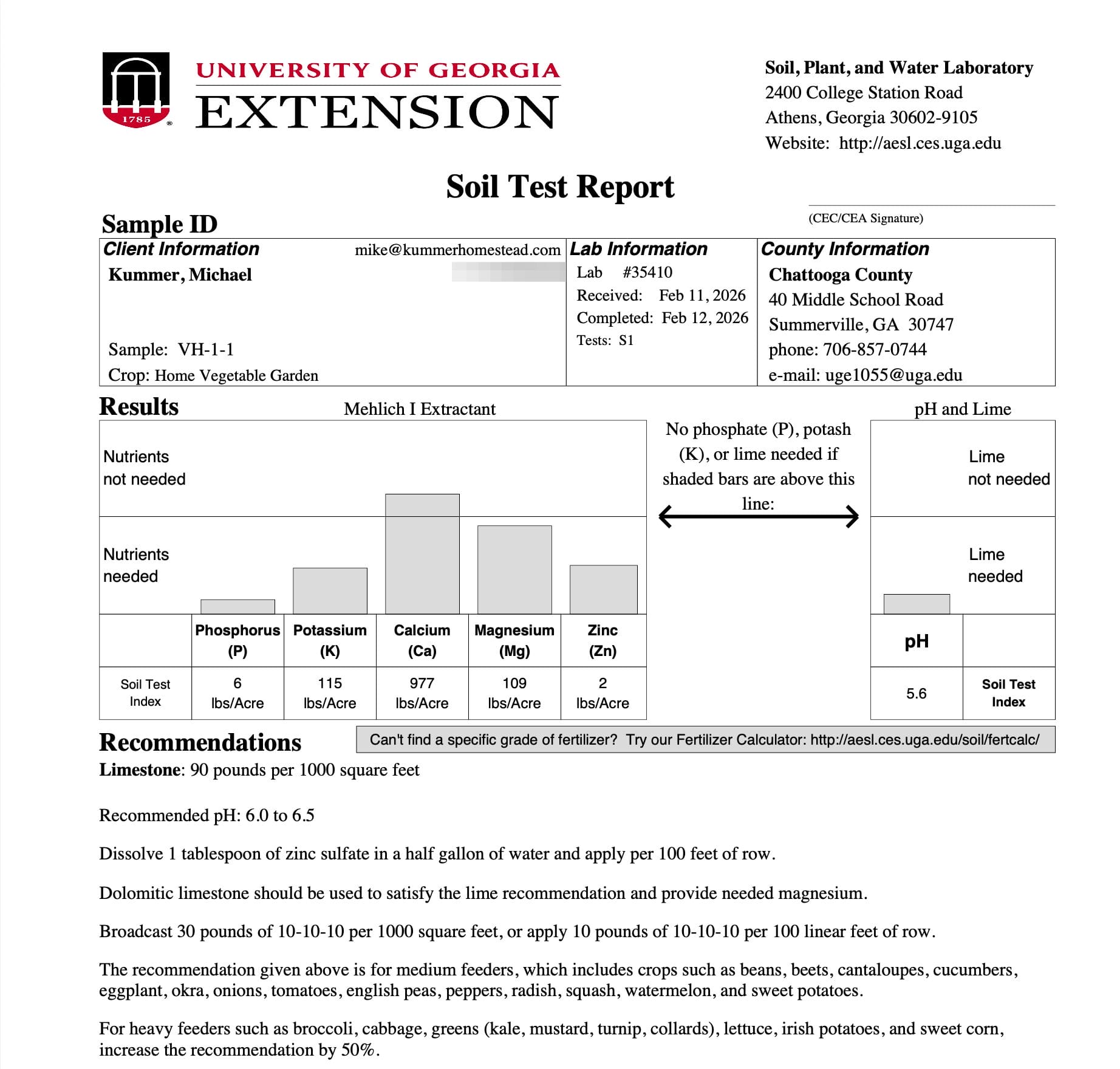
I don’t have to look further than our own homestead to see this play out. Our most recent UGA soil test (see the snapshot above) showed a pH of 5.4 in the orchard and 5.6 in the vegetable garden, both well below the recommended 6.0 to 6.5 range. Magnesium levels were rated “medium” in the orchard (121 lbs/acre) and “low” in the vegetable garden (109 lbs/acre).
The lab’s recommendation?
Apply dolomitic limestone specifically to provide needed magnesium.
Published data confirms the broader trend. A British study comparing government food composition records from 1940 to 2019 found that vegetables lost roughly 10% of their magnesium over that 80-year window.
In the U.S., researcher Donald Davis analyzed USDA data on 43 garden crops between 1950 and 1999 and estimated that modern produce contains 5% to 40% fewer minerals than it did two generations ago.
That kind of decline means the USDA food composition numbers I used to calculate my own daily intake probably overstate what I’m actually getting.
NIH data bears this out at the population level: nearly half of all Americans fall short of even the Estimated Average Requirement for magnesium from food alone.
Some researchers think that figure is too generous, because current intake recommendations were set using body weights from the late 1990s. Adjusted for what Americans actually weigh today, the shortfall may affect 50% to 75% of adults.
What a Day of Eating Actually Looks Like

I eat a lot of food, and my animal-based approach includes several low-toxin fruits that are solid sources of magnesium.
Here’s a typical day with approximate magnesium content based on USDA data:
On paper, that clears the 420 mg RDA. If you’re eating animal-based and including avocados, bananas and other fruits, you’re in better shape than someone on a strict carnivore diet. (A 2024 study in Nutrients found that strict carnivore meal plans delivered only 45% to 63% of the RDI for magnesium, with every single plan falling short.)
But as I mentioned earlier, the 420 mg target is based on a 166 lb reference man. At 215 lbs, I’m not the only one who outgrew that benchmark. A 2022 Advances in Nutrition paper noted that average American body weight has increased by roughly 20% since the RDA was set and argued that the true magnesium requirement for most adults is likely well above the current value.
Estimates of Paleolithic magnesium intake range from 600 to 800 mg per day. So even on my best day, I’m getting 60% to 75% of what my biology evolved to expect.
Factor in soil depletion (which inflates those USDA numbers) and the reality that only 30% to 50% of dietary magnesium is actually absorbed, and the math starts looking less comfortable.
What About Water?
You sometimes hear that drinking water can be a decent source of magnesium, and that’s true for certain mineral waters. A bottle of Gerolsteiner (a German sparkling water brand available widely in the US) contains about 108 mg of magnesium per liter. San Pellegrino comes in around 55 mg/L. If you’re drinking a couple of liters a day of something like that, you could be adding 100 to 200 mg to your daily intake without even thinking about it.
But most tap and well water doesn’t come close.
We have our own well on the homestead, and our 2023 UGA water analysis showed just 4.2 mg/L of magnesium. That means even if I drink three liters a day, I’m getting about 12 mg from water. It’s there, but it’s not moving the needle.
Municipal water systems are often even lower because treatment processes strip out dissolved minerals. If you’re on city water, you’re probably getting next to nothing. Mineral water can genuinely help close the gap, but it’s an expensive way to get your magnesium compared to a good supplement (like the one I use).
Stress and Exercise Make the Gap Worse

There’s another variable that rarely gets mentioned: lifestyle factors that actively drain your magnesium reserves.
The RDA was derived from metabolic balance studies conducted under controlled conditions. It doesn’t account for the kind of physical and psychological stress most of us deal with on a regular basis.
Magnesium is a cofactor in over 300 enzymatic reactions, including ATP production, protein synthesis and nervous system regulation.
Every time you exercise hard, you lose magnesium through sweat and increased urinary excretion. In fact, research suggests that athletes and people who train regularly may need 10% to 20% more magnesium than sedentary people.
I used to do CrossFit several times a week, before we began taking homesteading more seriously. These days, my exercise routine predominantly consists of lifting feed bags, shoveling dirt, pulling carts and pushing barrels. This isn’t what most people think of as an intense workout, but it’s physically demanding labor that still leads to magnesium depletion.
Chronic psychological stress is another drain. Cortisol and other stress hormones increase magnesium excretion through the kidneys, and the relationship works both ways: low magnesium levels amplify the stress response, which further depletes magnesium. It’s a vicious cycle that the official guidelines don’t really account for.
The bottom line is that if you exercise regularly, deal with work stress, sleep less than you should, or drink coffee (which also increases urinary magnesium loss), your actual requirement is probably well above the published RDA.
Why It’s So Easy to Miss Magnesium Deficiency
What makes all of this worse is that standard blood work won’t catch the problem.
The serum magnesium test your doctor orders measures what’s floating in the bloodstream, but that represents less than 1% of your body’s total magnesium.
About 60% is stored in bone, 27% in muscle, and the rest in soft tissue. Your body aggressively defends serum levels by drawing from deeper reserves, so blood tests can look perfectly normal even when your total stores are running low.
A 2018 review in Open Heart called subclinical magnesium deficiency “a principal driver of cardiovascular disease and a public health crisis,” noting that standard lab cutoffs miss roughly half of all truly deficient individuals.
If you want a more accurate picture, ask for an RBC (red blood cell) magnesium test, which reflects about 120 days of intracellular status rather than a single-moment snapshot of what’s in circulation.
The symptoms of low-grade deficiency are things most people write off as stress or getting older: muscle cramps, poor sleep, anxiety, heart palpitations, fatigue and headaches.
On the serious end, a dose-response meta-analysis pooling data from over 1 million participants found that each 100 mg increase in daily magnesium intake was associated with a 22% lower risk of heart failure and a 10% reduction in all-cause mortality. For a mineral that costs pennies a day, that’s a pretty compelling risk-reward ratio.
Not All Magnesium Supplements Are the Same
If you’re going to supplement, the form you choose matters. The differences in absorption and side effects between magnesium compounds are bigger than most people realize.
Why does combining forms matter? Because magnesium uptake is dose-dependent. Fractional absorption drops from about 65% at low doses to just 11% at high doses. Different forms use different transport mechanisms in the gut, so taking several at once lets you absorb more total magnesium without saturating any single pathway.
What I Use and Recommend

That multi-form logic is why I use Magnesium Breakthrough from BiOptimizers. It combines seven forms in a single supplement: chelate, bisglycinate, sucrosomial magnesium, malate, orotate, taurate and citrate.
Each two-capsule serving delivers 500 mg of elemental magnesium, and the formula includes Vitamin B6 as P5P (the active form), which research suggests makes magnesium about 40% more effective for stress reduction when the two are paired.
I like that you’re getting coverage across multiple absorption pathways and tissue targets in one product. Glycinate and taurate enter via dipeptide transporters; sucrosomial magnesium is absorbed through M cells in the intestinal lining; the rest use standard paracellular diffusion.
Each form also has a different tissue affinity (brain, heart, muscle), which means you’re not just absorbing more total magnesium but distributing it more broadly.
One fair criticism: BiOptimizers uses a proprietary blend, so you can’t see exactly how much of each form is in every capsule. That’s a real bummer and something I wish they’d change.
But based on my experience and the overall formulation, it’s still the most practical multi-form magnesium supplement I’ve come across.
If you decide to give it a try, use this link and enter discount code MK10 at checkout for 10% off.
Note: I’ve partnered with BiOptimizers to offer this discount to my readers, but I legitimately use this supplement and never recommend products I wouldn’t consume myself.
Bottom Line
An animal-based diet that includes avocados, bananas and other low-toxin fruits can get you to the current RDA for magnesium on a good day. That puts you ahead of most Americans.
But the RDA (for men) was built around a 166 lb man; it doesn’t account for exercise or stress, ancestral intakes were likely double what we consume today, and soil depletion means food databases probably overestimate what’s actually in your meals.
I don’t think of magnesium supplementation as patching a hole in my diet. I think of it as closing the gap between what modern food realistically delivers and what my body was built to run on.
I take it every day, and I’d encourage anyone eating the way I do to consider the same. Just skip the cheap magnesium oxide and pick something with multiple well-absorbed forms.
As I stated above, for me, that’s Magnesium Breakthrough from BiOptimizers.
Have you been supplementing with magnesium and if so, have you noticed a difference in sleep, recovery or how you feel day to day? Let me know by leaving a comment below.

Michael Kummer is a healthy living enthusiast and CrossFit athlete whose goal is to help people achieve optimal health by bridging the gap between ancestral living and the demands of modern society.