
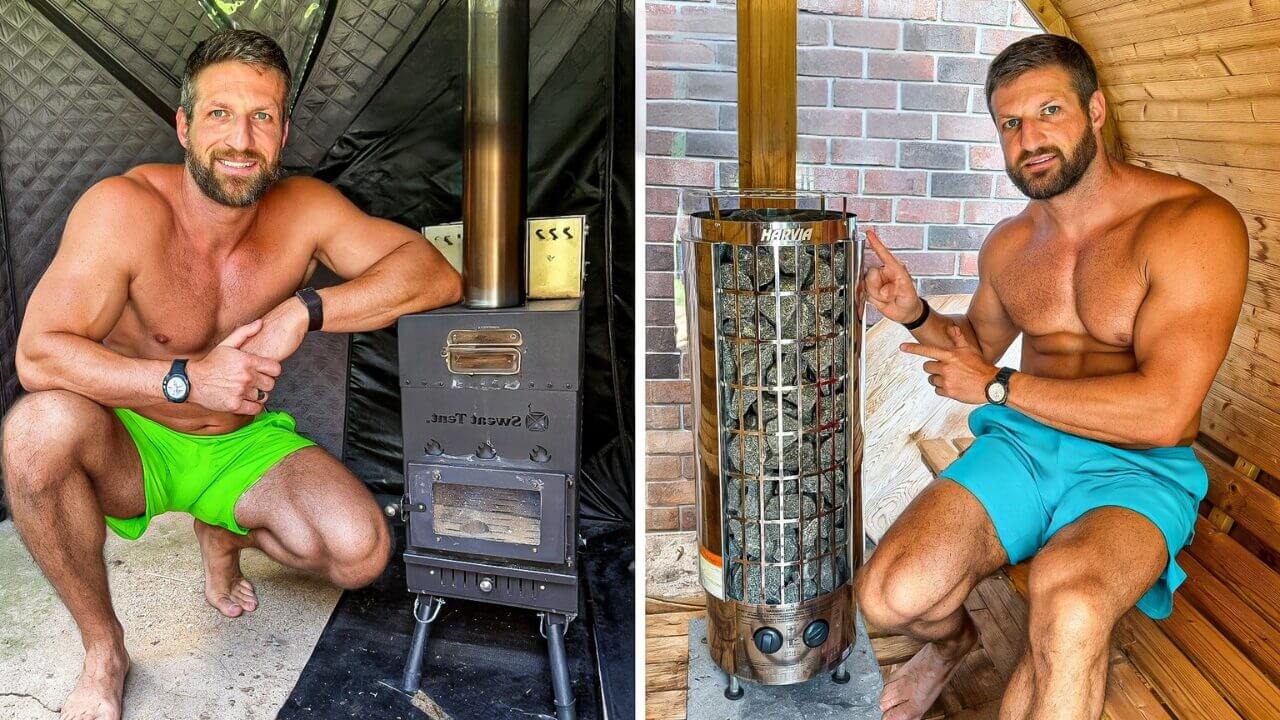
One of the first decisions you’ll have to make before investing in a traditional sauna is the type of heater you want to use. Traditional Finnish saunas typically use wood stoves, but most sauna manufacturers now offer electric heaters for convenience and safety reasons.
When we added a traditional barrel sauna to our home spa several years ago, I didn’t even consider a wood stove because I figured it’d be a hassle having to light a fire every time I wanted to use the sauna. As a result, we ended up with a relatively powerful electric heater from Harvia.
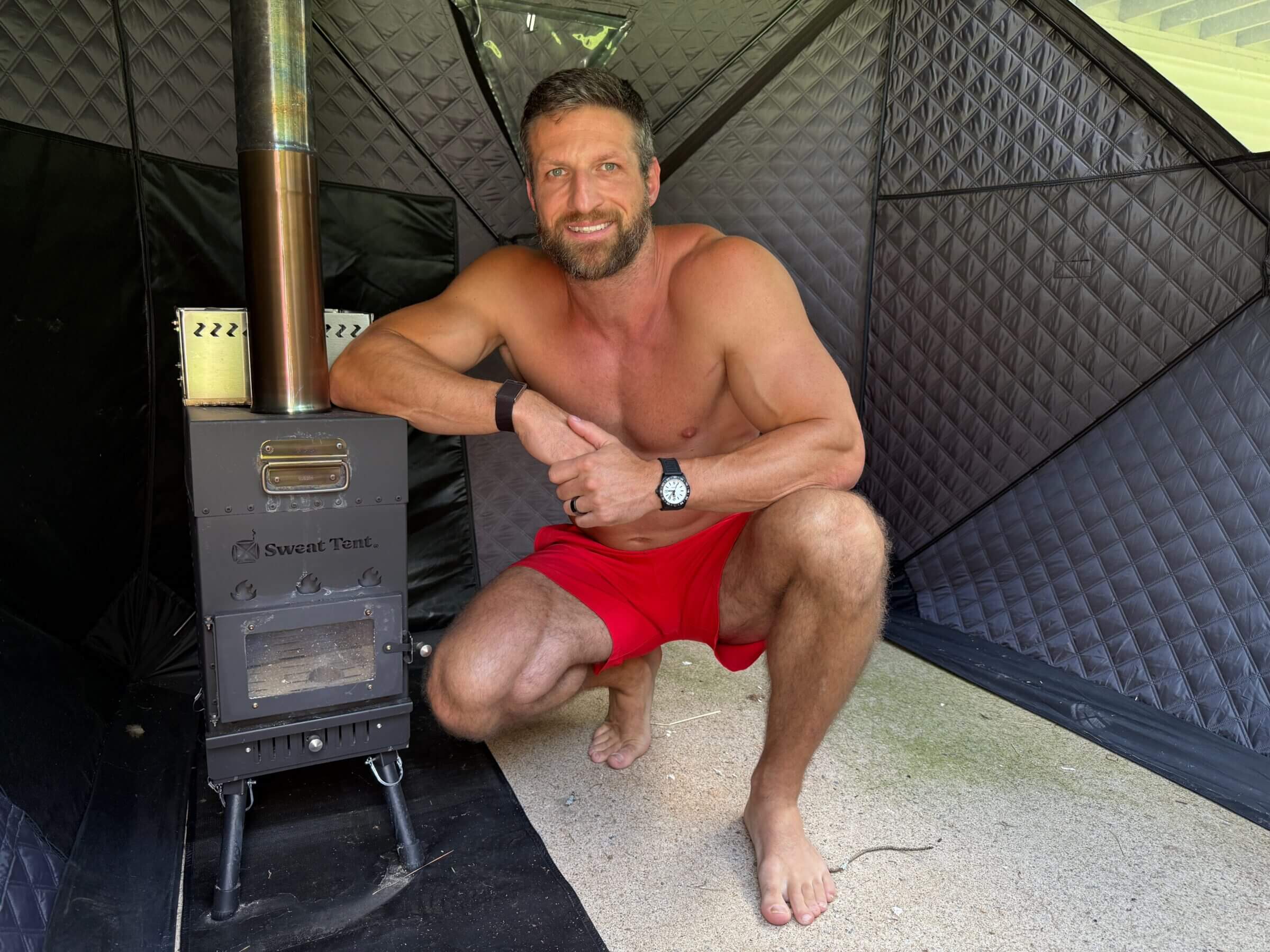
A few years later, a company called Sweat Tent reached out to me and asked if I wanted to review their wood-fired sauna. I still wasn’t convinced about the practicality of a wood stove, but I accepted the review unit. To my surprise, Sweat Tent’s wood stove outperformed our barrel sauna and electric heater in almost every category, and it completely changed my opinion on wood stoves.
In this article, I’ll share my first-hand experience with both heater types and compare them side by side in the following categories:
- Ambience and experience
- Convenience
- Heat time and max temperature
- Purchase cost
- Operating cost
- Safety
So let’s dive right in…
Ambience and Experience
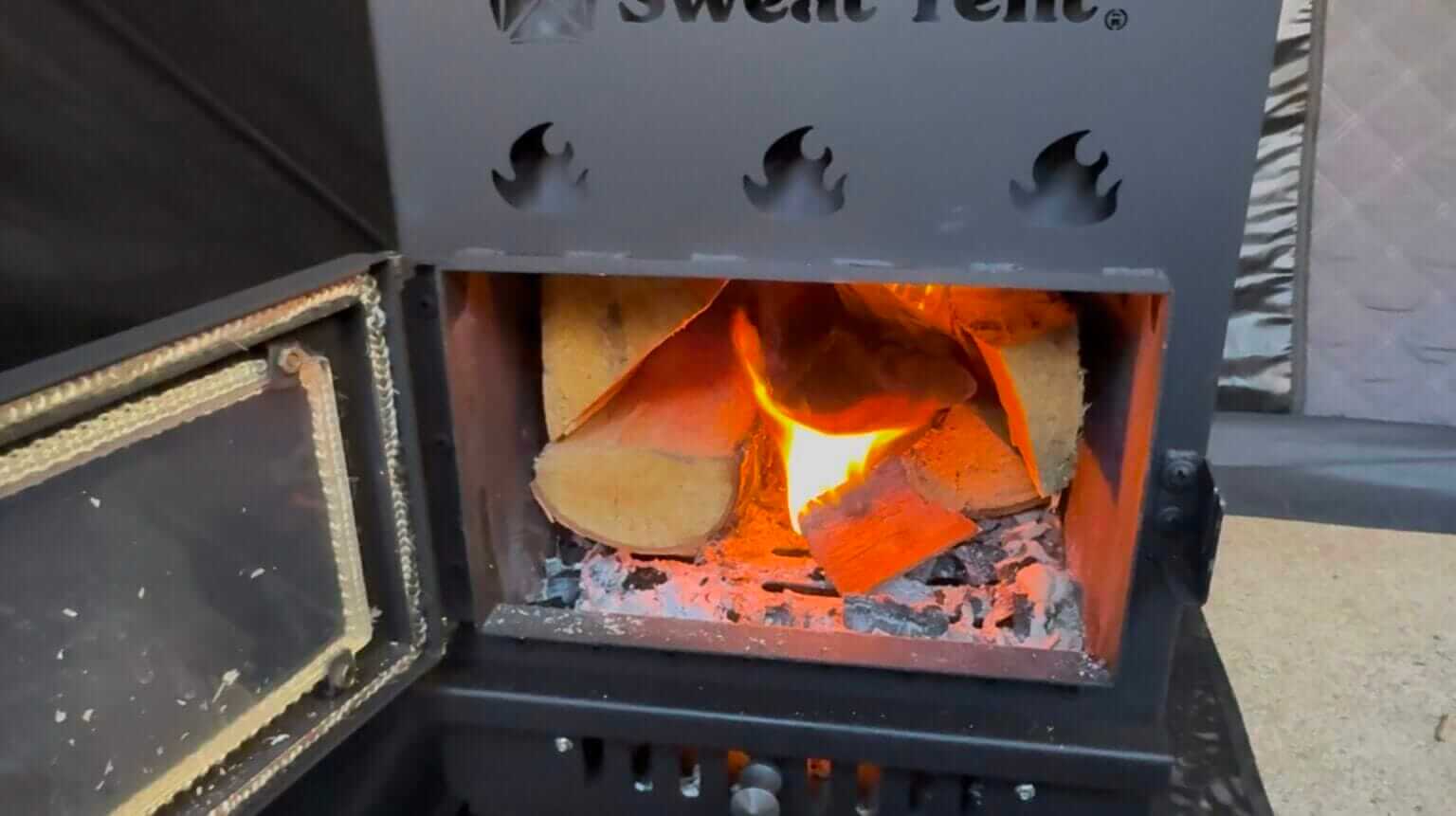
While I admit that how you experience a sauna session is highly subjective and depends on a variety of factors (e.g., what you hear, smell, feel and see), there is something special about how humans respond to fire and open flames. I don’t know if that goes back to the earliest times when humans discovered (how to make) fire, but there is just something special about sitting next to fire and listening to the crackling and smell of the wood.
You don’t get that with an electric heater. I mean, you might hear some creaking as the metal parts of the heater expand from the heat, but it’s just not the same thing. From that perspective, I’d argue that wood stoves have a leg up when it comes to delivering a truly authentic sauna experience.
Convenience
Modern electric heaters often feature WiFi connectivity that makes it incredibly easy to heat the sauna from the comfort of your couch instead of having to light a fire, which may take much longer (depending on your fire-making skills). The primary reason we equipped our barrel sauna with an electric heater was the lack of convenience associated with wood stoves.
But over the years, I’ve come to believe that the consistent need for convenience is the root cause of many of the health issues we face today. As a result, I often strive to avoid convenience in favor of authentic solutions that encourage me to reconnect with natural approaches and practices.
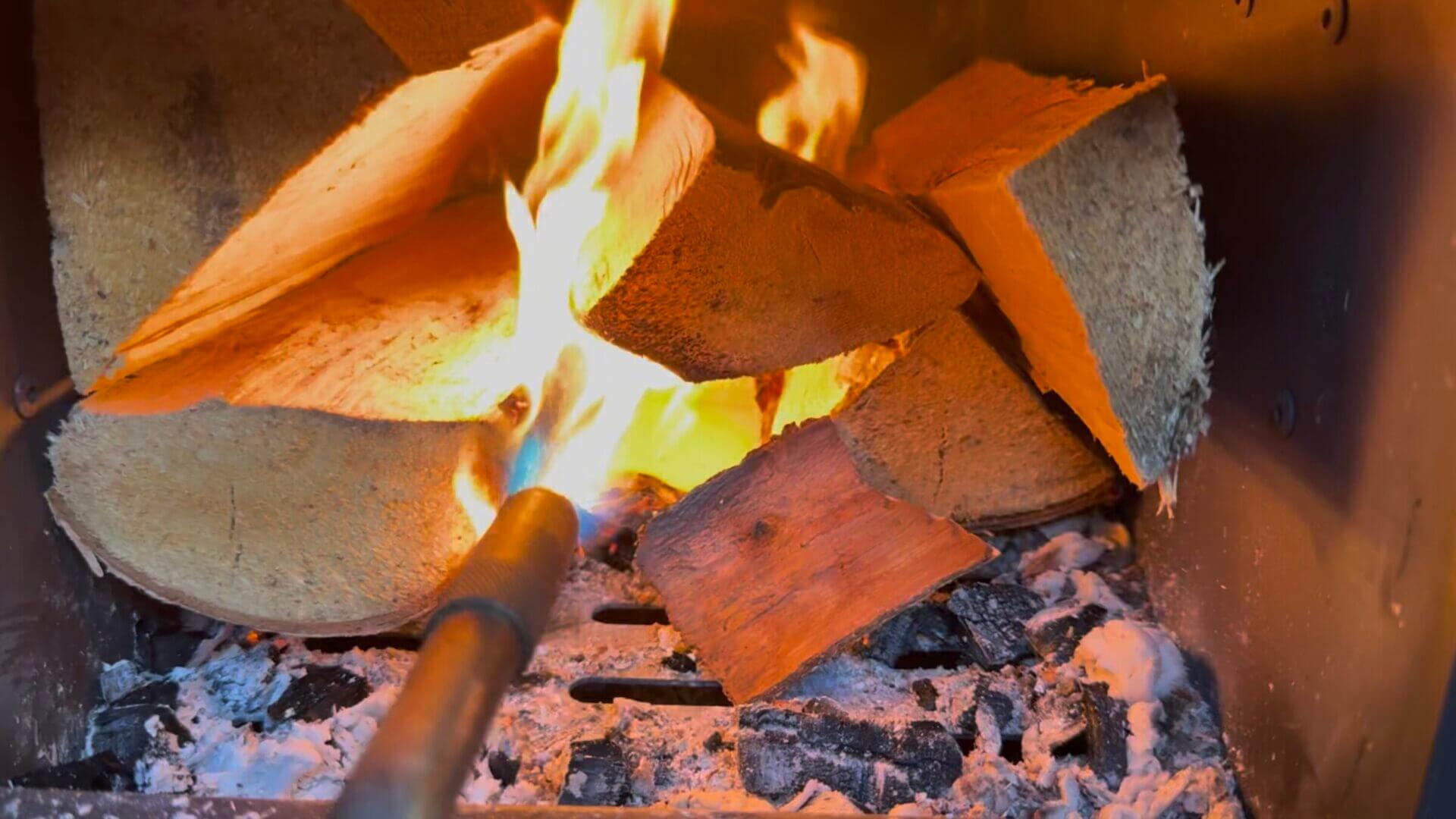
In the context of sauna bathing, I often prefer to light a fire instead of reaching for my phone and using an app to start my sauna session. A sense of accomplishment accompanies the former, whereas the latter is a recipe for getting distracted and spending more time than necessary on my phone.
Practically, I’ve realized that lighting a fire takes less than five minutes, and our wood stove heats our sauna more quickly than our electric heater. In other words, by using a wood stove, I actually get to enjoy the sauna sooner, which makes up for the five minutes it took me to light the fire.
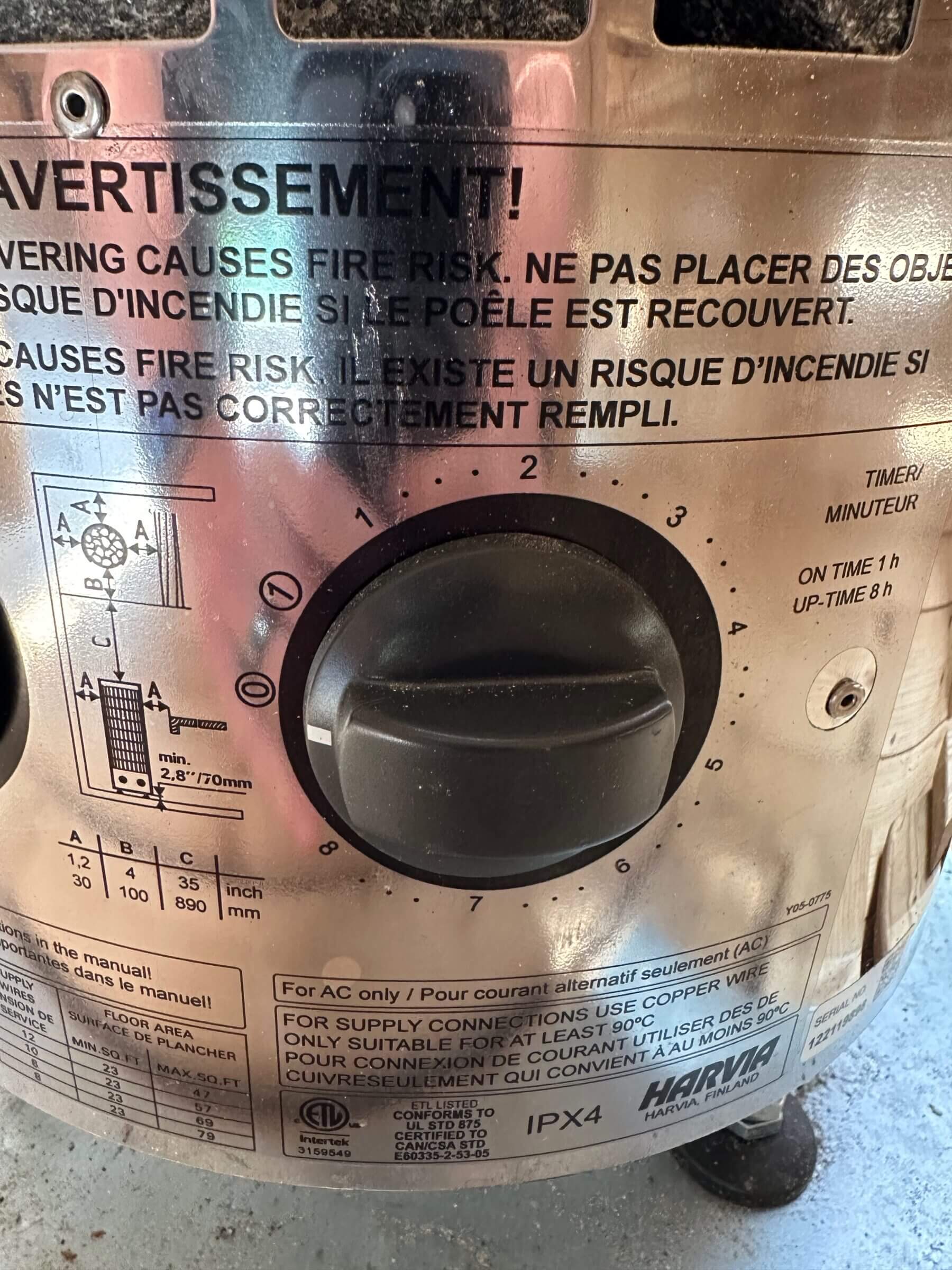
One notable “feature” of our electric heater is that it comes with a manual control knob, enabling me to turn the sauna on for up to one hour. Any longer, and the knob acts as a time delay. For example, if I set the knob to 90 minutes, the heater would turn on with a 30-minute delay and then heat for 60 minutes. Pre-heating the sauna usually takes about 45-60 minutes (depending on ambient temperatures). As a result, I have to time my entrance into the sauna precisely before the heater turns off, because the sauna cools down relatively quickly once the heater is off.
To put it another way, our particular electric heater proved to be much less convenient than our wood stove. Of course, if you have a more modern heater with WiFi connectivity, you likely won’t have to deal with the issues I described above.
Heat Time and Max Temperature
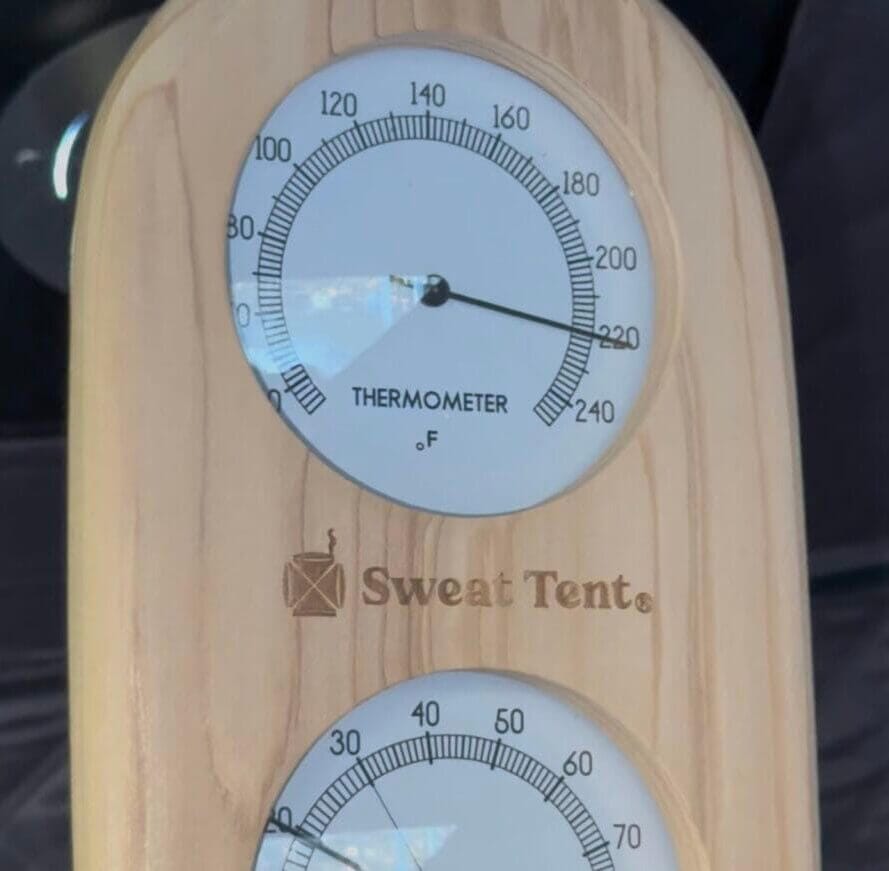
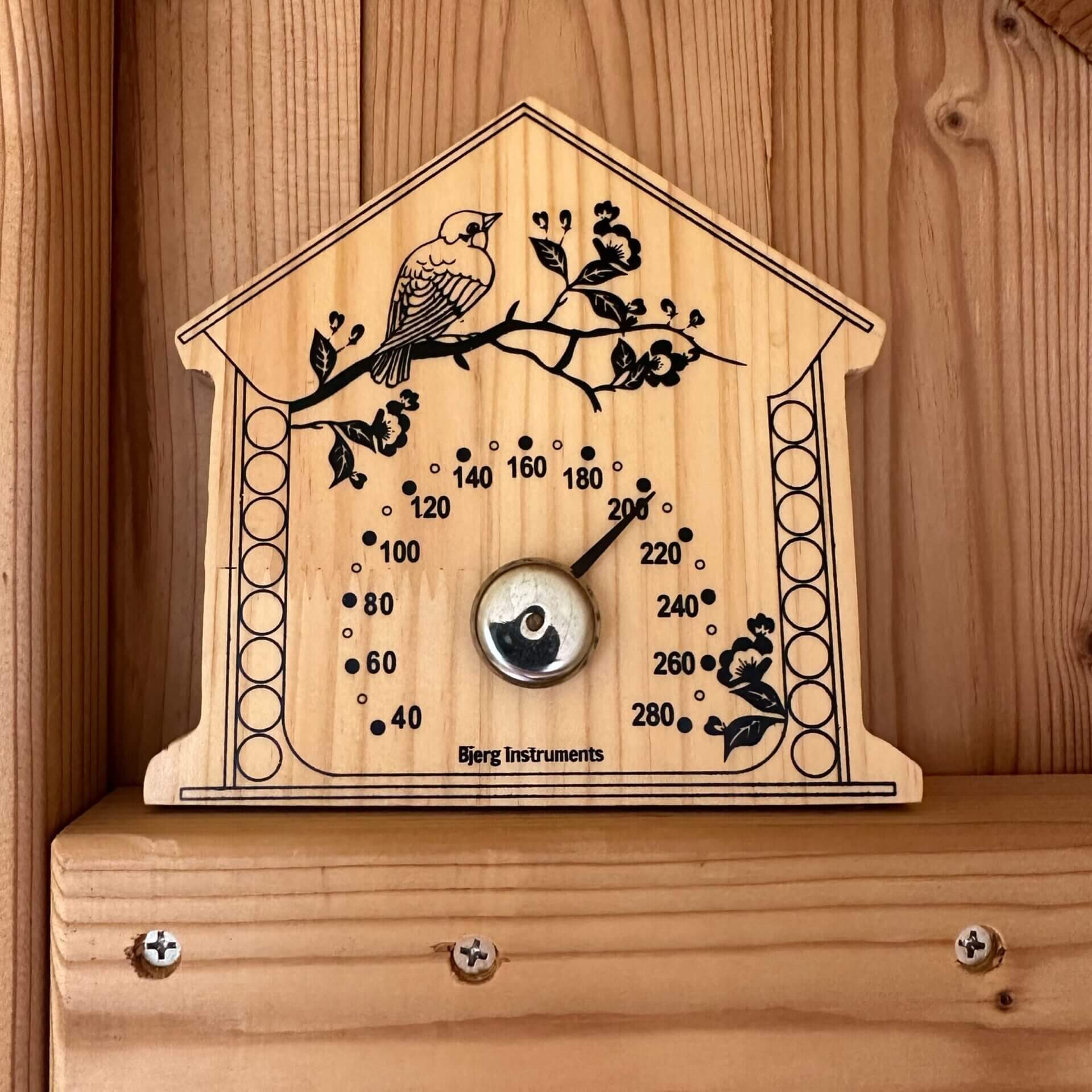
As I mentioned above, our wood stove heats up significantly faster than our powerful 9.6 kW electric heater. For comparison, our electric heater takes between 45 and 60 minutes to reach a temperature of over 200 degrees Fahrenheit, whereas our wood stove reaches the same temperature in approximately half that time.
One might argue that it doesn’t matter how long it takes for the sauna to heat up because you can always do something else while you wait. I tend to agree with that assessment, but have also noticed that depending on what I have on my plate, 45 minutes is just not enough time to complete a given task, and I end up doing nothing productive. In other words, I prefer waiting for 20 minutes instead of 45-60 minutes for the sauna to heat up.
Additionally, if I’m in a time crunch, I can begin my sauna session as soon as the fire is lit because of how quickly the inside of my Sweat Tent heats up. In other words, I start sweating within 15 minutes. Our barrel sauna with the electric heater doesn’t get hot enough for me to start sweating until around the 30-minute mark.
Another advantage of our wood stove is that it heats the inside of our Sweat Tent to a maximum of 240 degrees Fahrenheit. That’s 10-20 degrees hotter than I’ve gotten our barrel sauna up to.
I understand that not everyone can handle such high temperatures. But if you’re like me and want to reap the maximum benefits from each sauna session (e.g., growth hormone or heat shock protein release), you’ll appreciate the higher max.
Purchase Cost
The analog electric heater from Harvia, which we have in our barrel sauna, retails for just over $1,000. The app-enabled version costs over twice as much.
In comparison, our entire Sweat Tent, including the wood stove, sauna tent and accessories, retails for less than $1,500. Sweat Tent doesn’t sell the stove by itself, but I’ve seen comparable wood stoves made from 403 steel for less than $700.
That’s a significant price difference, considering that a full-size sauna, including an electric heater, costs several thousand dollars (more than $7,000 in the case of our Redwood Outdoors barrel sauna). Add on the cost of installing a dedicated 240V 50A electrical circuit and outdoor-rated breaker box, and you’re looking at an investment of close to $10,000.
You’d have to burn through a lot of firewood before reaching the higher price point of electric heaters (despite their often lower operating costs).
Operating Costs
Operating a sauna for personal use won’t break the bank, but there are regional differences in operating costs you may want to consider.
To give you some perspective, our electric heater consumes 9.6 kilowatt-hours. I estimate the heater to run for approximately 90 minutes per sauna session (60 minutes of preheating and 30 minutes of sauna bathing), resulting in 14.4 kW of power consumption.
In Georgia, we pay approximately 3 cents per kWh in the winter. That means each sauna session costs me less than 50 cents. For comparison, the same sauna session in California costs about 10 times as much.
A bundle of firewood here in the area costs somewhere between $5 and $7, and I’d use about half a bundle per session. As you can see, operating a wood stove is dramatically more expensive for me than using our electric heater. Of course, if you’re in California and/or you make your own firewood, the equation changes dramatically.
As a result, the choice between a wood stove and an electric heater (from an operational cost perspective) depends on where you live and the resources you have access to. Considering that I don’t use our saunas more than three times per week during winter, neither heater type breaks the bank.
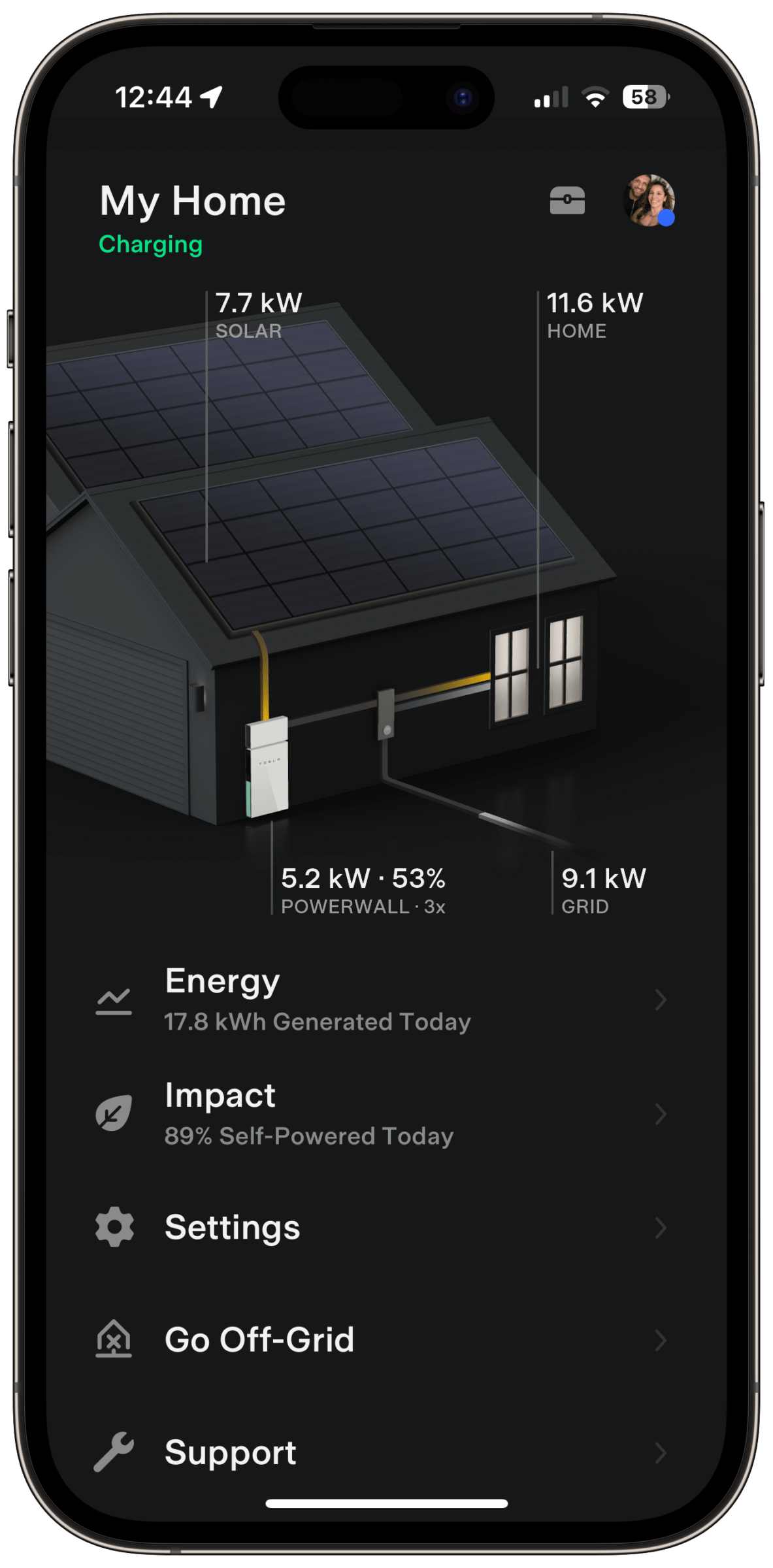
However, ever since we installed solar panels with batteries for backup in case of an outage, I’ve become more conscious of our electrical power consumption and prefer using the solar panels to charge our batteries rather than using the electricity. That has made me gravitate even more towards the wood stove approach, which avoids our electric heater consuming 100% of the energy our solar panels produce on even the sunniest of days.
Safety
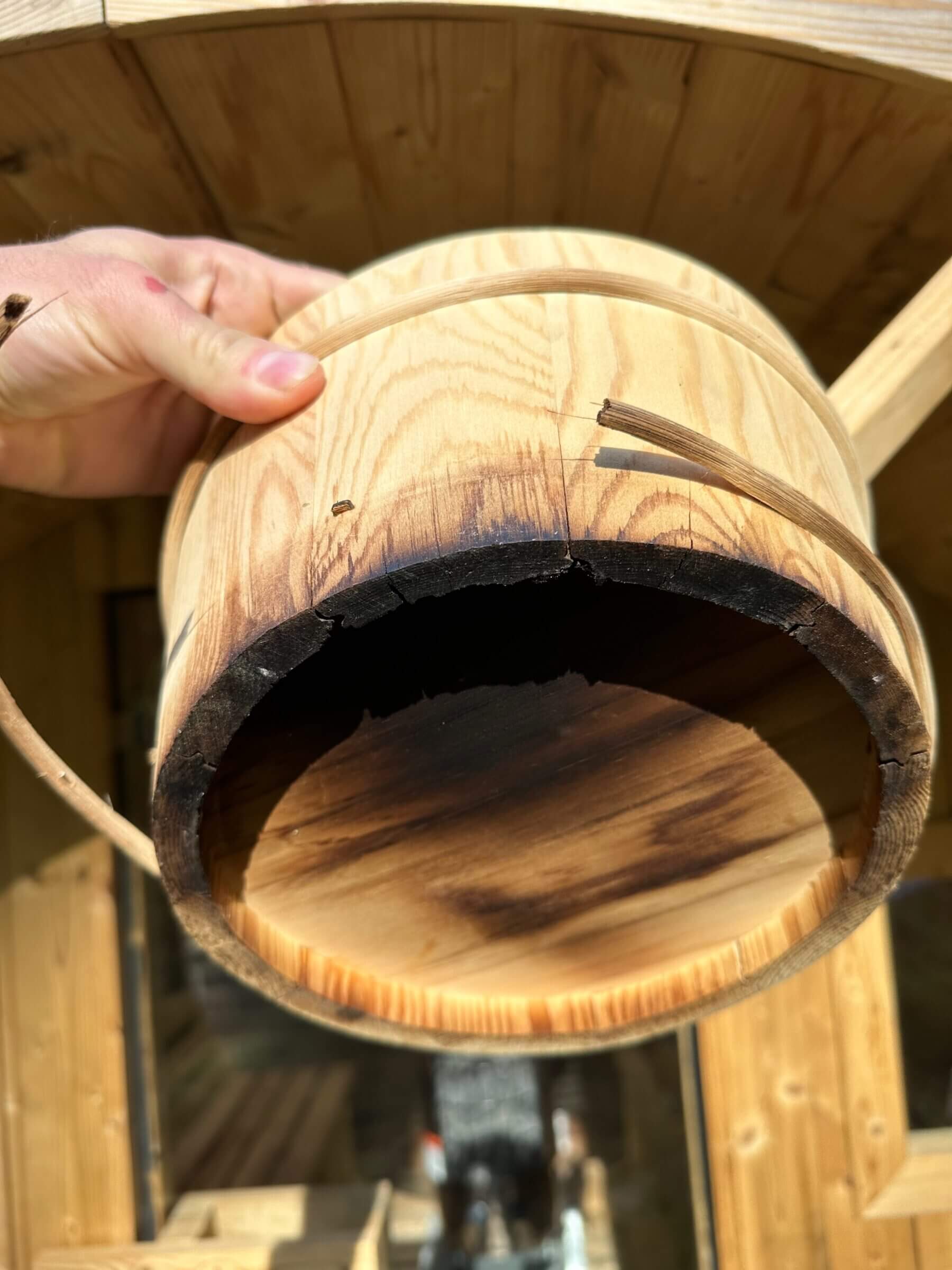
Both open flames and electricity can pose significant safety hazards, particularly when misused or in the presence of faulty equipment.
To reduce the risk as much as possible, we had our electrical heater installed by a trusted electrician. Considering that the heater is directly wired to a 240V and 50A supply line, I periodically inspect everything for potential damage (e.g., rats may chew through the conduits housing the wires coming from the house to the sauna in our backyard).
Additionally, there is a risk of burning yourself if you sit too close to the heater. Our barrel sauna is designed for six people, but I’d argue that you can safely sit only four adults, as the two remaining seats are directly in front of the heater, and I wouldn’t want to sit there.
Besides the risk of burns, wood stoves also pose a risk of carbon monoxide poisoning if there is a problem with the venting of fumes through the chimney. When we first assembled the stove and the flute pipes, I didn’t seat them fully, causing some of the smoke to leak into the tent. The problem was readily apparent, and I was able to fix it quickly; however, it served as a reminder that open fires in enclosed spaces pose a risk.
Overall, I’d argue that both heater types come with their risks, which are relatively easy to mitigate with proper installation, care and maintenance.
Summary and Final Thoughts
One of the most essential aspects of sauna bathing is consistency. Without it, you won’t reap many of the health benefits from this ancient tradition. From that perspective, I’d recommend choosing the heater type that appeals to you the most.
For a long time, electric heaters fit that bill for me because of their convenience, low operating cost and reasonably good performance. However, as I mentioned above, I’ve been steering away from convenience towards more traditional options.
After all, we don’t produce food on our homestead because it’s more convenient than relying on the grocery store – we do so because it’s healthier and more sustainable.
Similarly, I now prefer wood stoves over electric heaters. I enjoy lighting a fire, smelling the smoke and hearing the fire crackle – not to mention the immense heat those heaters produce.

Michael Kummer is a healthy living enthusiast and CrossFit athlete whose goal is to help people achieve optimal health by bridging the gap between ancestral living and the demands of modern society.