
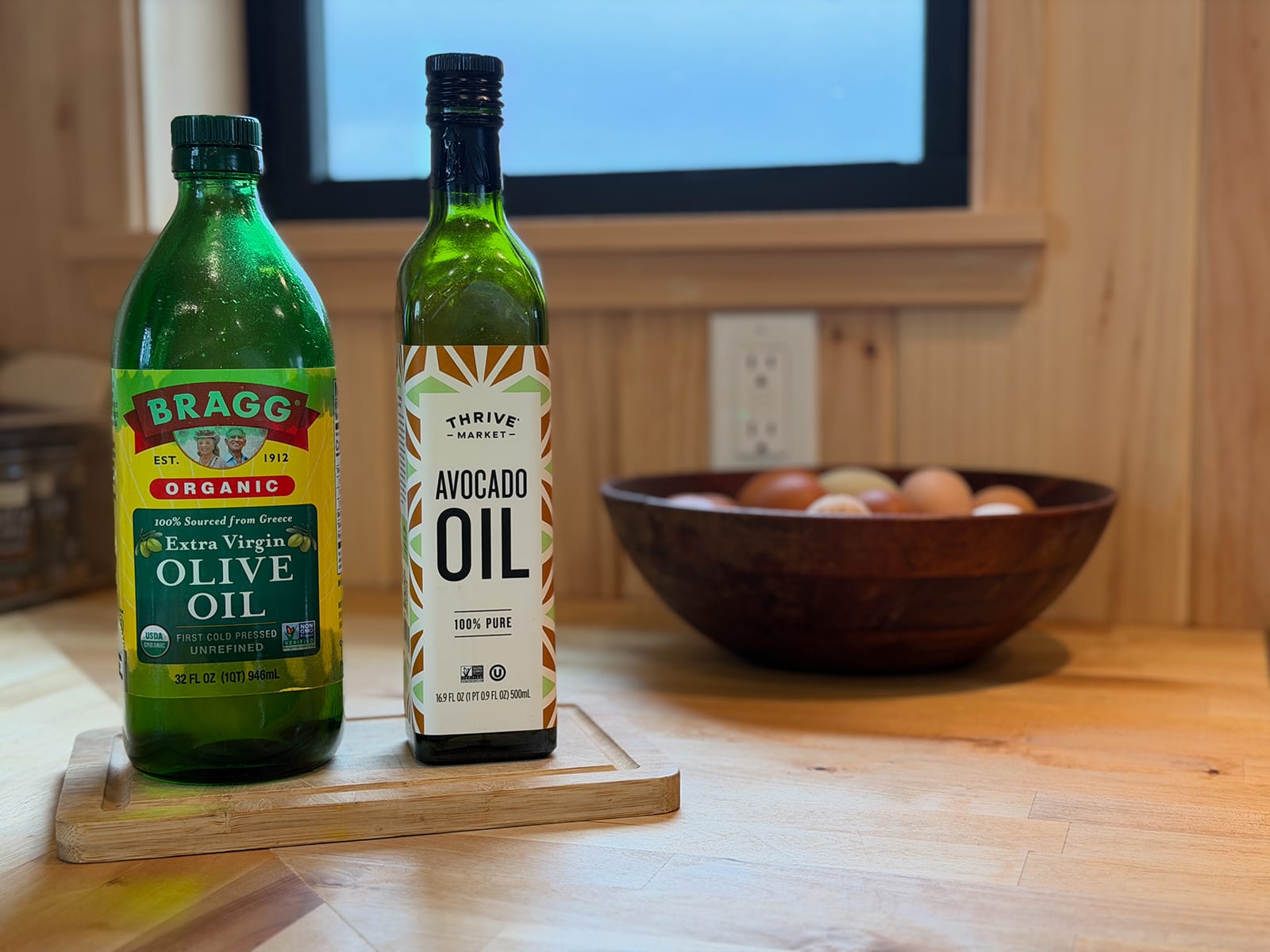
A few years back I was at the Alpharetta Farmers Market on a Saturday morning and stumbled across a vendor doing olive oil tastings — maybe a dozen different varieties from Greece, Italy, Spain and California. I worked through all of them, and I was genuinely surprised. Some were grassy and bright. One was almost peppery. Another was so mild it barely registered. It was the first time I really understood that “olive oil” is not a single, uniform thing.
I’ve been thinking about that morning lately because I get some version of this question constantly: Is avocado oil or olive oil better for you? It’s a legitimate question, and it deserves a more useful answer than the generic “both are healthy fats!” content that usually shows up when you search for it.
Before we dive in, here’s a quick head-to-head comparison…
| Avocado Oil | Extra Virgin Olive Oil | |
|---|---|---|
| Smoke point | 470–500°F | 375–405°F |
| Monounsaturated fat | ~70.5% | ~73.9% |
| Saturated fat | ~11.5% | ~13.5% |
| Polyunsaturated fat | ~13.5% | ~10% |
| Polyphenol content | Low | Very high |
| Flavor | Neutral | Distinctive |
| Best use | High-heat cooking | Finishing, dressings, moderate heat |
| Quality risk | Low–moderate | High (adulteration common) |
| Omega-6:Omega-3 ratio | ~13:1 | ~11:1 |
🥑 Avocado Oil
🫒 Extra Virgin Olive Oil
Framing the Avo vs. EVOO Debate
Here’s the thing: if you’re already asking whether avocado or olive oil is the better choice, you’ve probably already figured out that most of what’s on the grocery store shelves is a problem.
Canola oil, soybean oil, corn oil, sunflower oil safflower oil — these are all industrial products extracted with high heat and chemical solvents, loaded with linoleic acid (an omega-6 polyunsaturated fat), and prone to oxidizing both during processing and when you cook with them.
Dr. Cate Shanahan has famously called these the “Hateful Eight,” and that framing is apt.
I’ll admit that I spent years believing the opposite. I grew up being told that saturated fat was the enemy — that animal fats clogged your arteries and that switching to vegetable oil was the smart, modern choice. I bought it, like most people did.
It took years of reading the actual research, tracking my own blood markers, and eventually arriving at a framework grounded in evolutionary biology before I understood how badly wrong that conventional wisdom is. If you’re still working through that transition, I get it. It takes time.
The moment you start asking “avocado vs. olive,” you’ve already left that category behind. That matters. Both of these oils are genuinely reasonable choices for cooking, and I use both of them in my kitchen.
But I want to give you the full picture before I get into the comparison, because the full picture includes something most avocado-vs-olive articles skip entirely.
Where These Oils Fit in the Cooking Fat Hierarchy
I’ll be upfront: from an evolutionary standpoint, neither avocado oil nor olive oil is at the top of my list.
The fats humans cooked with for most of our history came from animals: tallow (rendered from beef or bison), lard (from pork), ghee and butter.
These fats are predominantly saturated and monounsaturated, which makes them chemically stable at high temperatures. They don’t oxidize easily. And – unlike refined vegetable oils, which only became a mass commodity about a century ago – they’ve been central to the human diet for a very long time.
At the Kummer household, Kathy and I cook with tallow and ghee first. We render our own tallow from the grass-fed whole cow we buy each year from a local Georgia farm. When a recipe doesn’t call for animal fat — or when we want something with a different flavor profile — that’s where avocado oil and olive oil come into the picture.
So if you’re building your cooking fat pantry from scratch: start with tallow, ghee, butter and lard. Then add olive oil and/or avocado oil. That hierarchy matters.
Defining “Fat” and “Fatty Acid”
Before we get into the numbers, a quick note on terminology…
You’ll see me use the terms “fat” and “fatty acid” throughout this article, and while most people use them interchangeably, they’re not technically the same thing.
Fatty acids are the molecular building blocks of fat; fat is essentially what you get when fatty acids are assembled together.
For the purposes of understanding what’s in your cooking oil and how it behaves in your body, the distinction doesn’t change anything practical. But it’s worth knowing, because the health properties of any given oil come down to which specific fatty acids it contains and in what proportions.
There are three main categories: saturated fatty acids (stable, found predominantly in animal foods and some tropical oils), monounsaturated fatty acids (one double bond between carbon atoms — stable enough, found in olive and avocado oil), and polyunsaturated fatty acids (multiple double bonds — less stable, prone to oxidation, and where most of the problems with industrial seed oils originate).
As a general rule: saturated and monounsaturated fats are your friends. Polyunsaturated fats, especially in the form of industrial seed oils, are not.
Avocado Oil
Pros
- Very high smoke point (~470–500°F for refined versions) — well-suited for high-heat cooking.
- Neutral flavor that doesn’t compete with other ingredients.
- Over 70% monounsaturated fat, predominantly oleic acid.
- Retains meaningful vitamins and phytosterols when properly processed.
Cons
- Polyunsaturated fat content (~13–14%), while modest, is higher than tallow or ghee.
- Heavily refined versions may strip beneficial compounds.
- Less nutritional complexity than a quality extra virgin olive oil.
Fat Composition
Refined avocado oil is approximately 70.5% monounsaturated, 11.5% saturated, and 13.5% polyunsaturated per 100 grams.
| Fatty Acid Type | Per 100g |
|---|---|
| Saturated | 11.56g |
| Monounsaturated | 70.56g |
| Polyunsaturated | 13.49g |
The overwhelming majority of its fatty acids are either stable saturated fats or oleic acid — a monounsaturated fat with a solid track record in the research literature.
For example, a 2013 review published in Mini-Reviews in Medicinal Chemistry found that oleic acid exerts meaningful modulatory effects on cardiovascular health, inflammatory disease, and immune function; specifically, that diets rich in oleic acid appear to improve immune response and support the body’s ability to clear pathogens, while also showing benefit in autoimmune and inflammatory conditions.
In other words, this isn’t a fat that just sits there doing nothing. It’s an active contributor to how your body functions.
Now, at around 13-14%, its PUFA content is modest compared to the industrial seed oils I mentioned earlier. But PUFAs – especially linoleic acid – are prone to oxidation when heated. The high smoke point of refined avocado oil limits that somewhat, but it doesn’t eliminate it entirely, which is one reason I still prefer animal fats for the highest-heat applications.
Smoke Point
Refined avocado oil has a smoke point of 470-500°F, which puts it among the highest of any cooking oil. It’s well-suited for searing, high-heat roasting, and frying. The brand we’ve used most at home, Chosen Foods, consistently performs at the upper end of that range.
Nutrients
Carefully processed avocado oil retains meaningful amounts of Vitamin E, Vitamin K, potassium, magnesium, and lutein/zeaxanthin (carotenoids relevant to eye health).
Chosen Foods reports that their refinement process retains roughly 80% of the beta-sitosterol and around 60% of the Vitamin E found in virgin avocado oil. I can’t independently verify those figures, but the brand is transparent about its process, which I appreciate.
Taste
Refined avocado oil is essentially flavorless. If you want the fat to disappear into whatever you’re cooking — searing a steak, frying eggs, putting together a marinade — it works without altering the flavor of the dish.
For people who simply don’t enjoy the taste of olive oil, avocado oil is the obvious alternative.
Quality Concerns
Back in 2020, UC Davis researchers conducted the country’s first comprehensive study of commercial avocado oil quality and purity, analyzing 22 domestic and imported samples.
Their finding? At least 82% were either stale before the expiration date on the bottle or adulterated with cheaper oils. In three cases, bottles labeled “pure” or “extra virgin” avocado oil contained nearly 100% soybean oil.
The researchers followed up in 2023 with a second study focused on private label store brands, testing 36 products purchased from 19 retailers across the US and Canada. Nearly 70% were rancid or mixed with other oils. Only 31% tested pure.
The reasons for this are straightforward: avocado oil is expensive, the profit margin on adulteration is significant, and until very recently there were no enforceable standards that gave the FDA any authority to regulate it.
The Codex Alimentarius — the international food standards body — only adopted global avocado oil standards in late 2024 (which is essentially yesterday in regulatory terms). Without enforceable standards, fraud is easy to commit and hard to prosecute.
The practical takeaway is the same one I apply to olive oil: buy from brands that are transparent about their sourcing and supply chain, and be suspicious of anything priced suspiciously low. The 2020 UC Davis study found that only two brands — Chosen Foods and Marianne’s Avocado Oil — passed both purity and quality standards.
Chosen Foods, which is a brand we’ve use at home (get it on Amazon), has since implemented batch testing and grove-to-bottle traceability. That doesn’t mean other brands can’t be trusted, but it does mean price alone is not a reliable signal of quality.
Olive Oil
Pros
- Exceptionally rich in polyphenols, particularly oleocanthal and oleuropein.
- Polyphenols specifically protect LDL from oxidation — where the real cardiovascular benefit lies.
- Long history of human consumption.
- High-quality extra virgin varieties are minimally processed.
Cons
- Lower smoke point (~375–405°F) than avocado oil.
- Quality is wildly inconsistent — adulteration in the industry is a genuine, documented problem.
- More susceptible to oxidation from light and heat during storage; buy in dark glass and use within a few months of opening.
Fat Composition
Extra virgin olive oil comes in at approximately 73.9% monounsaturated, 13.5% saturated, and 10% polyunsaturated per 100 grams — a slightly better PUFA profile than avocado oil.
| Fatty Acid Type | Per 100g |
|---|---|
| Saturated | 13.46g |
| Monounsaturated | 73.90g |
| Polyunsaturated | 10.00g |
Smoke Point
Most extra virgin olive oil has a smoke point around 375-405°F, which is more than adequate for everyday cooking — sautéing, moderate-heat pan work, roasting at standard oven temperatures.
The idea that olive oil is too delicate to cook with is a myth. The International Olive Oil Council has confirmed that olive oil is chemically stable when heated, and its high monounsaturated fat content means it doesn’t break down the way PUFAs do.
For frying at extended high heat, I’d still choose avocado oil or tallow — but for the vast majority of what happens in a home kitchen, olive oil handles itself fine.
Polyphenols: The Real Story
This is where extra virgin olive oil genuinely earns its reputation, and it’s usually framed wrong.
You’ve probably heard that olive oil is “heart-healthy” because it lowers cholesterol. That framing misses the point.
Total LDL cholesterol is a poor standalone predictor of cardiovascular risk. LDL only becomes a problem when it oxidizes — and oxidized LDL is largely a product of a diet high in inflammatory PUFAs and processed carbohydrates, not dietary cholesterol or saturated fat.
The reason high-quality EVOO is worth keeping in your kitchen is that its polyphenols — particularly oleocanthal, oleuropein and hydroxytyrosol — have been shown to protect LDL from oxidation. That’s a meaningful and specific mechanism, and it’s a completely different argument than “it lowers your cholesterol numbers.”
It’s also worth understanding just how much research sits behind these compounds. By some estimates there are over 15,000 published studies on olive oil’s phenolic compounds, compared to roughly 300 on avocado oil’s nutritional profile.
That gap reflects how much longer olive oil has been a serious subject of scientific inquiry — but it also reflects a genuine difference in nutritional complexity.
Avocado oil’s value is primarily in its fatty acid profile. Olive oil’s value is in its fatty acids and its polyphenols. That distinction matters more than smoke point, in my opinion.
Olive Oil Quality Is Not Guaranteed
I can’t stress this enough: a substantial portion of commercially sold “extra virgin olive oil” is not what the label says. Studies have repeatedly found that many oils marketed as EVOO have been diluted with cheaper refined oils, processed at high heat rather than cold-pressed, or stored past the point where the polyphenols have degraded. If you’re buying the cheapest olive oil on the shelf, you’re probably not getting the benefits I just described.
Look for a brand that discloses its olive source, uses a single origin, and cold-presses its oil. The one I keep coming back to is Kasandrinos; they source exclusively from Greek olives and are transparent about their process. I’ve been using their EVOO for years. (Use code MK50 to save 50% on your first subscription order.)
We’ve also been purchasing Bragg brand olive oil, which is available on the shelf at Sprouts (as well as via Amazon).
Taste
Olive oil has a real, distinctive flavor — grassy, sometimes peppery, occasionally almost buttery depending on the variety and origin.
I like it. Not everyone does.
If you’ve tried one olive oil and written off the whole category, I’d encourage you to try a few more versions before you give up on it. The range is surprisingly wide.
That afternoon at the Alpharetta Farmers Market is what convinced me to pay more attention to where my olive oil comes from.
Which One Should You Use?
My honest answer: both. They serve different purposes, and you don’t have to choose.
The way I think about it in my own kitchen: avocado oil for high-heat applications, EVOO for finishing and anything at moderate heat. And when I’m searing something that really needs temperature stability — a thick ribeye, for instance — I reach for tallow first.
If you’re starting from scratch and can only buy one: go with a quality extra virgin olive oil. The polyphenol content is harder to replicate, and between the two, a good EVOO contributes more to your overall nutritional intake than a neutral refined oil.
But don’t overthink it. Both of these oils are a significant upgrade over anything made from industrial seeds, and the perfect is the enemy of the good.
What About Omega-3s?
One thing worth addressing directly: neither avocado oil nor olive oil is a meaningful source of omega-3 fatty acids. Their omega-6 to omega-3 ratios run approximately 13:1 (avocado oil) and 11:1 (olive oil). Those numbers aren’t alarming by the standards of most cooking oils — but they’re not a substitute for actually getting omega-3s into your diet.
If you’re eating grass-fed beef, fatty fish, and pastured eggs (skip any other type, for the reasons explained here) regularly, you’re probably covering a significant portion of your needs through food.
But if you want to be deliberate about your EPA and DHA intake, a quality supplement is worth considering. We recently added a Wild Alaskan Salmon Oil to the MK Supplements lineup — wild-caught, cold-processed, and bottled in glass so there’s no plastic leaching into the oil. If that’s a gap in your current stack, it’s worth a look.
Frequently Asked Questions
Yes, within reason. The idea that EVOO becomes toxic when heated is not supported by the evidence. Its high monounsaturated fat content and antioxidant compounds make it more chemically stable than most plant-based oils. For everyday sautéing and roasting up to around 375–400°F it performs well.
For example, a 2007 study published in the Journal of Agricultural and Food Chemistry heated extra virgin olive oil at 356°F for 36 consecutive hours and found it still retained most of its nutritional properties — which should put to rest the idea that a few minutes in a sauté pan is going to destroy it.
Where I’d exercise more caution is extended high-heat frying — for that, avocado oil, tallow, or ghee is the better call.
No. Its oleic acid content is actually associated with reductions in inflammatory markers in several studies (see here and here), and its relatively modest PUFA content means it doesn’t contribute to the omega-6 overload that drives inflammation the way seed oils do. Calling it powerfully anti-inflammatory is probably overstating it — but it’s a reasonable fat that doesn’t work against you.
From an ancestral and chemical stability standpoint: tallow, lard or ghee. Among plant oils, refined avocado oil or coconut oil are the better choices — their higher saturated and monounsaturated fat content makes them more resistant to oxidation at frying temperatures. Olive oil can handle moderate-heat frying, but I wouldn’t use it for an extended high-heat fry.
Strict carnivore advocates would say no. My view is more practical: if you’re metabolically healthy and these are your cooking fats, they’re unlikely to cause problems. They’re not organ meat, but they’re also not canola oil. I’ve moved from strict carnivore to an animal-based framework, which accommodates both oils without issue.
If you’re using carnivore therapeutically to address an active health problem (like IBS, as I did), you might consider eliminating them temporarily and seeing how you feel. But as a long-term approach for a metabolically healthy person, I don’t think either oil is something to stress about.
A few practical rules: buy from a brand that discloses its olive source and harvest date (not just a best-by date). Cold-pressed from a single origin is a good sign. Store in a dark glass bottle away from heat. Expect to pay a real price — cheap olive oil is almost certainly not what the label claims. And trust your senses: quality EVOO should smell and taste like fresh olives. If it’s bland and odorless, something is off.
The Bottom Line
Both avocado oil and olive oil have a place in a well-stocked kitchen. They’re not interchangeable — they have different strengths — but both represent a meaningful upgrade over industrial seed oils, and both fit cleanly within an animal-based or paleo framework.
My practical setup: Bragg or Kasandrinos EVOO finishing and moderate-heat cooking; refined avocado oil when I need higher heat; tallow or ghee when I’m searing or doing anything that really demands temperature stability.
If you’re going to prioritize one, start with a quality extra virgin olive oil. The polyphenol content is the deciding factor, and it’s hard to replicate with any other plant-based oil.
Now I’d like to hear from you:which oil do you reach for most in your kitchen, and has your approach changed as you’ve cleaned up your diet? Leave a comment below.

Michael Kummer is a healthy living enthusiast and CrossFit athlete whose goal is to help people achieve optimal health by bridging the gap between ancestral living and the demands of modern society.

https://drbrianparr.files.wordpress.com/2013/03/dietary-fats.jpg
Missing from this graphic is mainly avacado oil, and for possible comparison, walnut oil, cod liver oil, chia, hemp, fish oil, krill oil, high polyphenol olive oil, and other sources of dietary fat like eggs, avacados, whole milk, goat, sheep cheeses, spirulina, Chlorella etc…
Great read, I’m always trying to better my intake of foods. Its hard with a large Family but we always try. So I usually buy from Costco and get the extra virgin cold press Olive Oil and thoughts on it quality? Also cut all added sugars and artificial sweeteners from diet. Its disturbing how addictive this stuff is and how much they hide it in our food supply. I didn’t know there are literally hundreds of sweeteners that generate insulin production making us all fat!
Hey Kyle,
to be honest, I’ve heard so many bad things about various olive oil brands and since I can test their quality myself, I stopped using EVOO. We use mostly grass-fed butter, tallow and ghee these days. Since we don’t eat salads, we have little need for liquid fats :)
Cheers,
Michael
Coconut oil is terrible for you since it’s incredibly high in saturated fat. I’m surprised you suggested even using it, being a nutrition enthusiast. “The current Dietary Guidelines for Americans recommend consuming no more than 10% of total calories from saturated fat. And last year the American Heart Association (AHA) released a scientific advisory statement recommending the replacement of saturated fats in the diet, including coconut oil, with unsaturated fats. In their statement, the AHA cited and discussed a review of seven randomized controlled trials, in which coconut oil was found to raise LDL cholesterol levels.” – Harvard
Hi Brandon!
It’s been decades since Ancel Keys came up with the BS theory that saturated fats are bad for your health and there are still people (and government organizations) out there that keep parroting this misinformation. So let me make it very clear: There is zero connection between the intake of saturated fats and heart (or any other) disease. Please stop spreading misinformation. Here is a list of recent clinical trials that debunk that myth: https://www.healthline.com/nutrition/5-studies-on-saturated-fat
The real problem is polyunsaturated fatty acids from seed and vegetable oils. Stay away from those and you’ll be fine as have humans over millions of years eating predominantly animal fats.
Totally agree. AHA also recommends
Canola
Corn
Olive
Peanut
Safflower
Soybean
Sunflower
mostly crap.
Lots of folks have issues with PUF causing inflammation, especially people with thyroid problems. There is a brand of EVOO marketed by a famous doctor (not Oz) that contains 30x polyphenol than garden variety EVOO. Olive oil polyphenols have been shown to blast cancer cells in vitro. So they may or may not fight active cancer but I’d wager try can help prevent it. So I’d say best to cook with avocado oil and use super polyphenol EVOO as a drizzle or dip or to make pesto sauce.
I was disappointed there was no “side by side” comparison between the two oils. That chart would show the heating point, fats, vitamins also varieties and costs. Which is better in baking cakes, cookies and muffins. Only a side by side comparison would do for making a fully informed choice.
Good Valerie, thanks! I’m actually in the process of updating the article and also writing another one, comparing all the cooking oils. I’ll take your feedback into account for those two tasks. So check back in a bit please!
Cheers,
Michael
Did you make a comparison chart?
Hi Darlene,
Unfortunately, I still didn’t get to that — too many competing priorities. The goods news is, the comparison article/chart is still on my to-do list.
Cheers,
Michael
I STARTED MAKING MY SALAD DRESSINGS WITH HALF EV OLIVE OIL ORGANIC CERTIFIED AND USDA ORGANIC AVOCADO OIL BECAUSE I FELT THE OLIVE OIL MADE IT BITTER. I THINK IT IS A GOOD MIX AS I GET THE BENEFIT OF BOTH HEALTHY OILS AND LESS BITTERNESS!
Avocado Oil helps lower blood pressure Known to provide essential fatty acids. Good source of vitamins. Contains high amounts of fiber. Helps lower cholesterol level.
I live a low-carb ketogenic lifestyle and subsequently am always on the lookout for good, nutritious fats and oils. I have been a big fan of EV olive oil for salads especially, and more recently have come to love avocado oil. My favorite olive oil is O Extra Virgin California Olive Oil. They also make a range of balsamic vinegars, and I especially like their white balsamic vinegar. I have tried several avocado oils, and for salads, my all time favorite is Primal Kitchen’s extra virgin California avocado oil. It has a clean, fresh, avocado-y flavor that is delicious in salads. They also make a “regular” avocado oil that has less of a distinctive taste that I use for cooking.
I started drinking the lemon/olive oil tonic in the morning (OMG Delicious!!) would using Avocado oil heed the same detox and anti viral benefits? Should I just use EVOO for this? Thx!
Hi Lisanne,
medically, there is no such thing as “detox,” with the exception of “the medical treatment of people with life-threatening drug addictions.” So don’t buy into the detox scam.
Regarding anti-microbial properties of olive oil, there are studies that show that olive oil offers a barrier to foodborne pathogens when you ingest contaminated food. See https://www.ncbi.nlm.nih.gov/pubmed/17536679. But that does not mean that drinking olive oil will kill a cold virus you got from shaking hands with someone who has a cold.
Hi Lisanne,
Your comment on detox is inaccurate as most doctors aren’t trained in natural foods for health.
While I’m aware that western medicine knows little about the impact of foods on human health, detoxing is something the body does by itself. Just stop exposing yourself to toxins and eat a diet that promotes the loss of body fat (where toxins are stored). There is nothing you have to eat specifically or supplement with to speed up that process.
Research shows that unsaturated fats are far better for humans than saturated and transfats. I believe you have a typo in your post where you state:
“As a rule of thumb, saturated and monounsaturated fats are good for your health, but you should stay away from polyunsaturated fats.”
Hi Jay,
It is not a typo, but my statement was in reference to vegetable oils. I clarified that in the article. But generally speaking, there are two main categories of polyunsaturated fatty acids: omega-3 and omega-6. In oils, the ratio between those two is important from a health perspective. There is a link in my article that goes into more details about that. You may also be interested in checking out https://thepaleodiet.com/the-importance-of-the-omega-6-omega-3-ratio-to-human-health.
Hi, may you do a comparison between Avocado vs. Castor oil? I’d truly appreciate it. Thank you
Hi AfroBoho!
I only know Castor oil from skin care, never heard anyone using it for cooking :)
Cheers
Michael
I tried frying with this new oil. It is refined high oleic sunflower oil with 83% monounsaturated fat (doctors say it is the good fat). It is call sunvella frypure. I got considerably better results frying with it than with anything else I tried. Did any one else hear about it? Try it? What do you think?
Hi Edward,
One of the key factors with oils is their Omega 6 to Omega 3 ration. The lower that factor the better. Typical sunflower oil has a lot of Omega 6 and no Omega 3. For an explanation why that is important, check out: https://thepaleodiet.com/vegetable-oil-fatty-acid-composition/
You may also find https://michaelkummer.com/fat-cholesterol-friends/ interesting.
I hope that helps!
UK readers might like to know that Tesco has recently started selling South African Cold Pressed Extra Virgin Avocado from Pure South Press, 250 ml for £2.50.
I eat a humongous salad most days for lunch, and have been for years now (I eat a low carb paleo-ish diet for the past ~7 years now). I have always used EVOO and balsamic for dressing (I just pour some in and then stir the whole salad up)…until last week I went to make a salad and was out of EVOO and found a bottle of Avocado oil that my wife had bought. I gave it a try and was pleasantly surprised – it is mostly tasteless but it seems to bring the flavor of the salad (the peppers, the tuna, etc.) out more, whereas the EVOO just kind of dulls or takes over the taste. Big fan now! I also find I use less of the avocado oil, which makes the price difference a net/net cheaper deal.
I use both, Cal. Ranch olive oil (Robust) and Chosen Foods avocado oil daily. (One Tbl. each a day) I stir fry w/ Avocado oil. use on salads and veggies, soups, etc.